.
.
The simple heddle is central to all handloom weaving and deserving of attention. Modern handlooms are usually fitted with mass-produced polyester or wire heddles, but the making of bespoke string heddles was once a craft in its own right, practised by both weavers and specialist heddle makers. For the last couple of years heddle making has been intrinsic to my practice and part of my mission to recover and preserve traditional weaving skills.
In this post I look at some old heddles and share some photographs of my first attempt at heddle making in 2024.
.


.
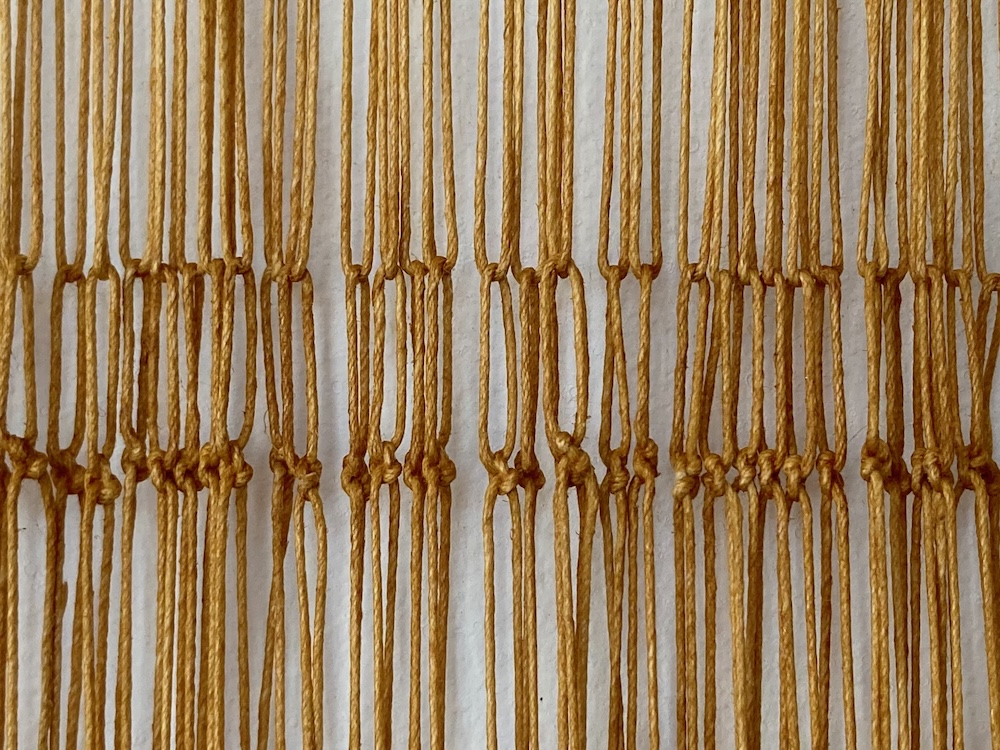
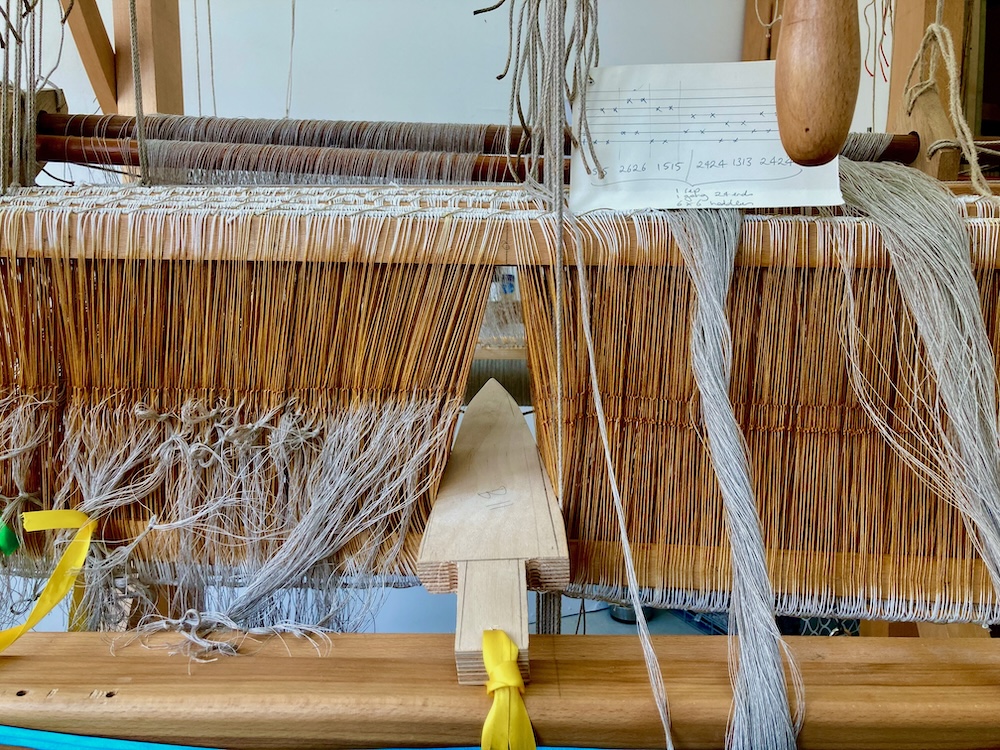
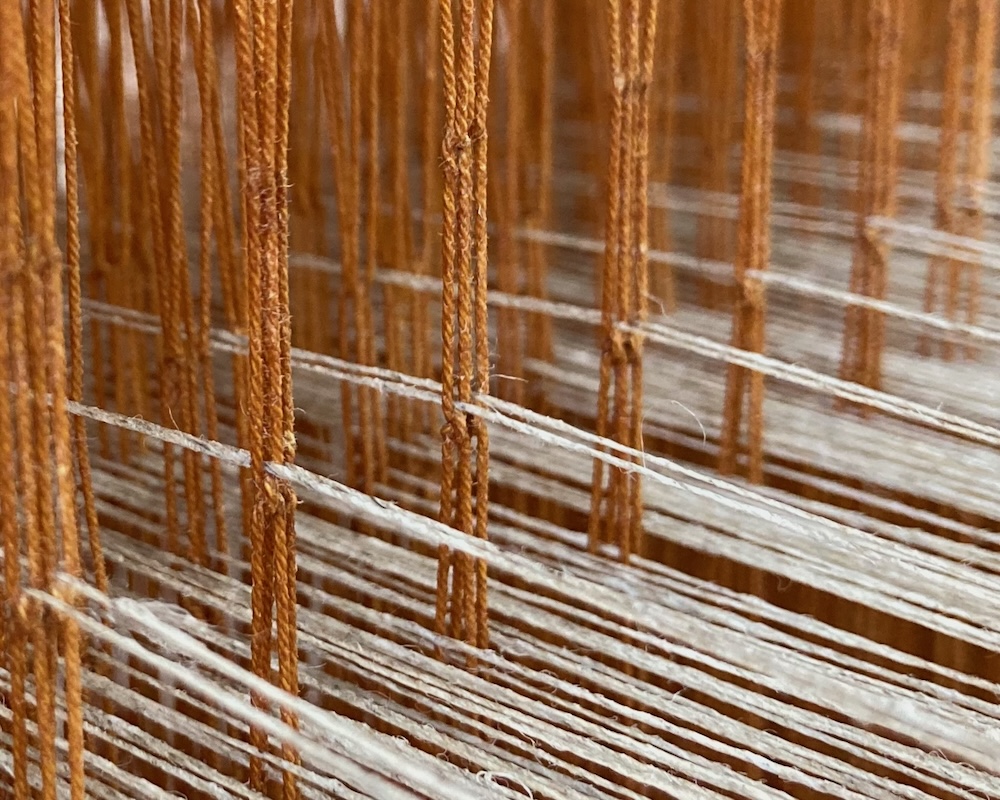
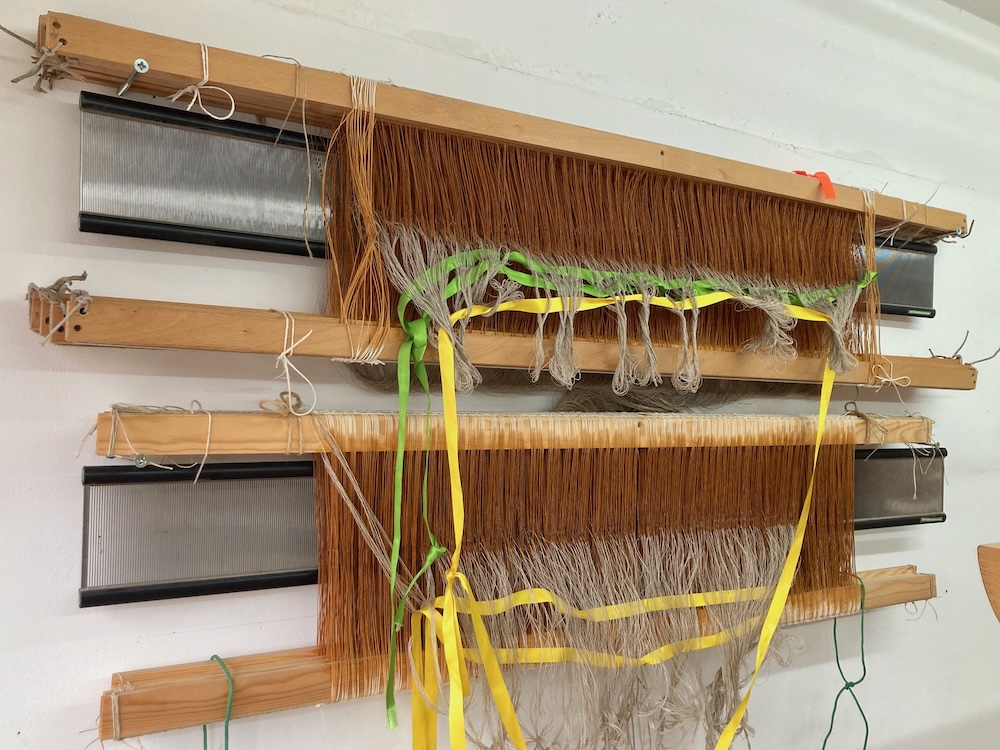
The photographs above show three sets of old string heddles. The first belongs to a nineteenth century loom at the Ballyduggan Weavers’ Cottage at the Ulster Folk Museum in Cultra, Northern Ireland. They are a fairly typical set of old heddles: apparently hand-knitted and bespoke, each heddle knotted to cords running along top and bottom shafts and therefore having a fixed sett. These are coated in varnish to make them more resilient. 1 The second photograph shows a detail of one of twenty leaves of heddles used to weave damask diaper at Bankfield Museum in Halifax made by a specialist heddle maker in 1958 (you can read more about these heddles here). The third & fourth photographs show a set of unusual ‘clasped’ heddles used for weaving linen in Norfolk (which you can read more about here).
Each set of heddles was made for weaving a specific cloth. This specificity is a key characteristic of old string heddles and a contrast to the flexibility of modern heddles. The number and spacing of the heddles along the shaft were fixed to correspond with a certain sett and weave structure. If a loom was to be used to weave a different fabric the heddles would be removed and stored, with the reed, and usually still threaded with the remnant or ‘thrums’ of the previous warp. This whole apparatus of heddles, shafts, reed and thrums was referred to as ‘gear’. Although it takes time to make a set of heddles, time is also saved by tying-on a new warp to an existing set of gear rather than re-threading the heddles.
.
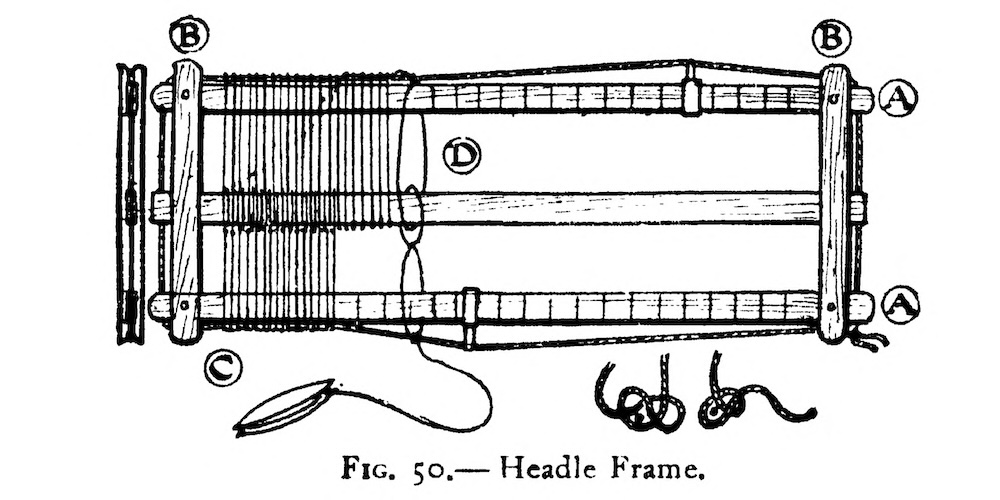
A frame for heddle making is shown above in an illustration from Luther Hooper’s Hand-Loom Weaving Plain & Ornamental (1920) where it is accompanied by a good desription of the basic principles of heddle making, which I quote in full at the bottom of this post.
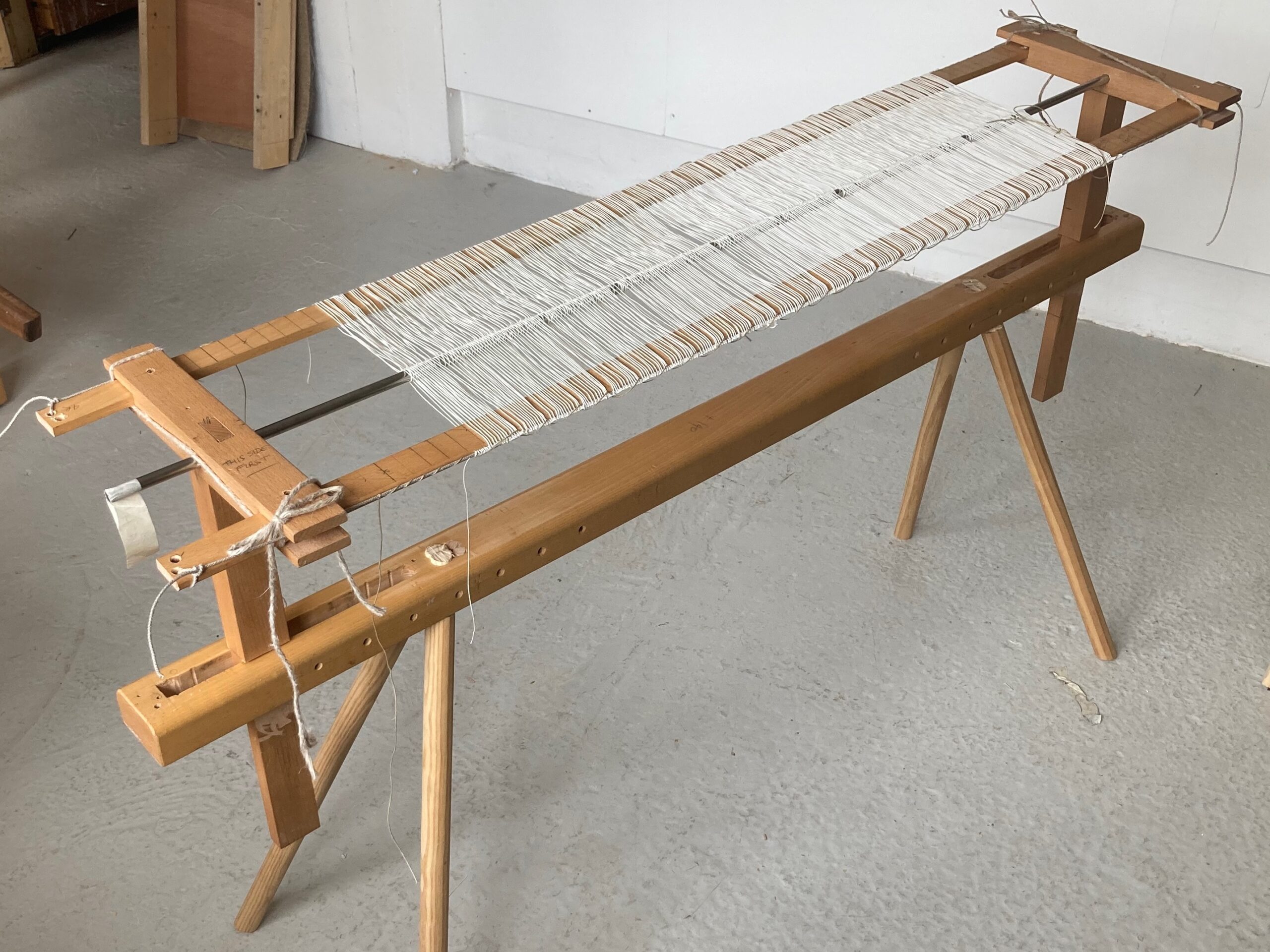
I first learnt to make heddles by watching the weaver Justin Squizzero at the Marshfield School of Weaving in Vermont. The frame I use is roughly copied from Justin’s antique heddle frame, with the shafts and heddles held horizontally at a convenient height for working seated.
At the time of writing I have made five sets of heddles and still consider myself a novice. It is not my intention here to give a step-by-step guide to the process, although I may try that once I am more confident in my method.
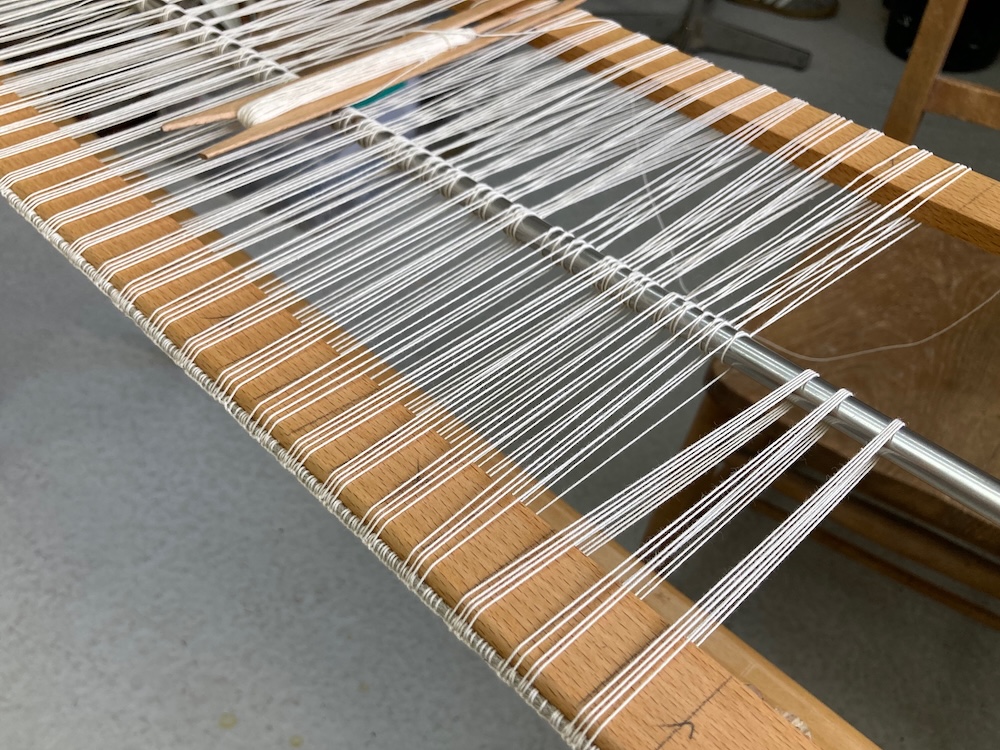
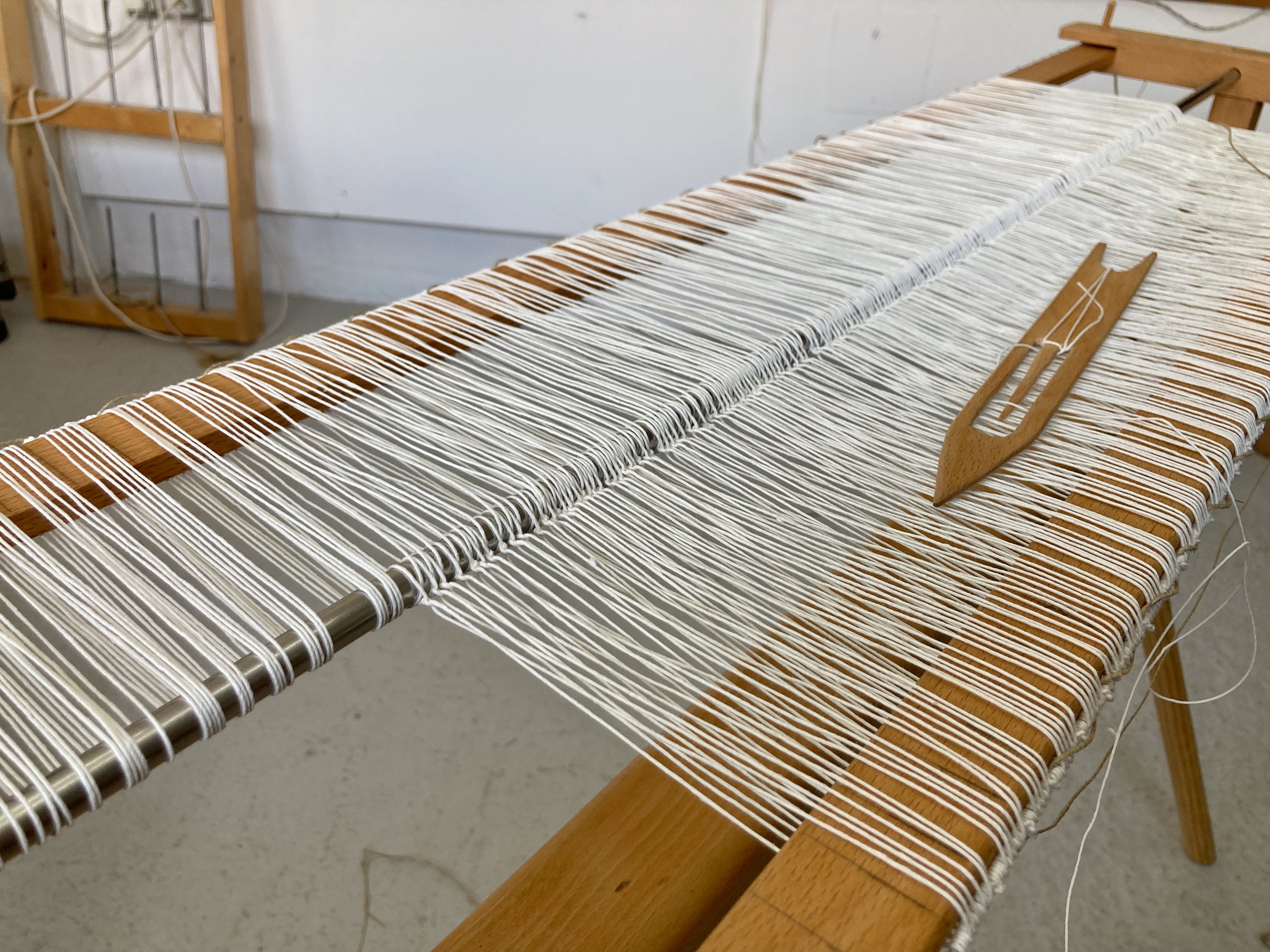
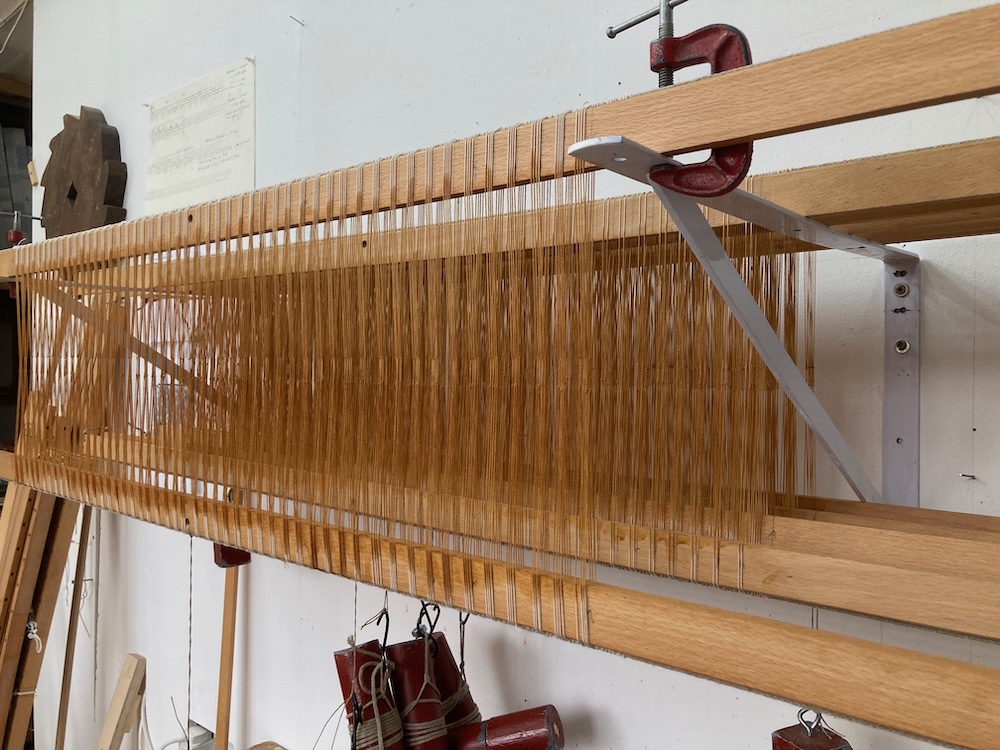
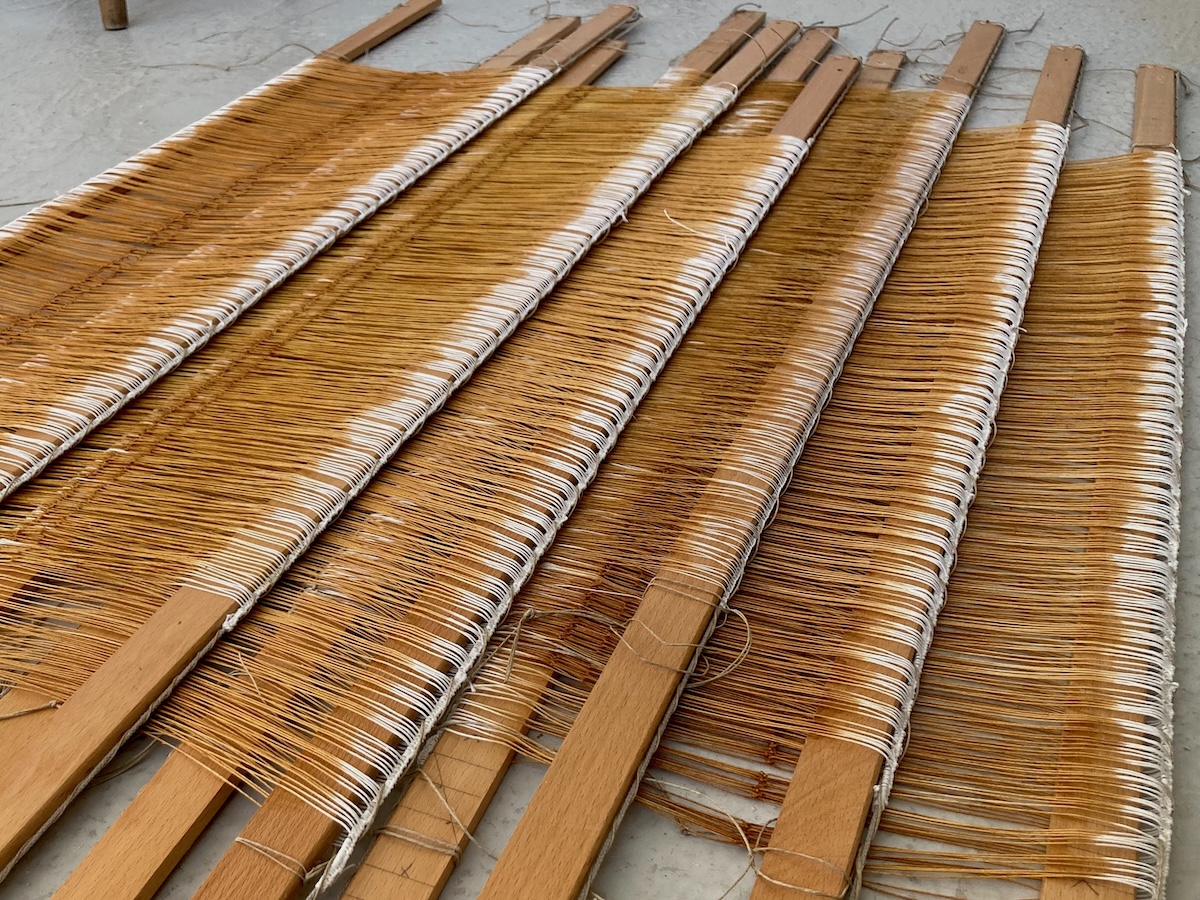
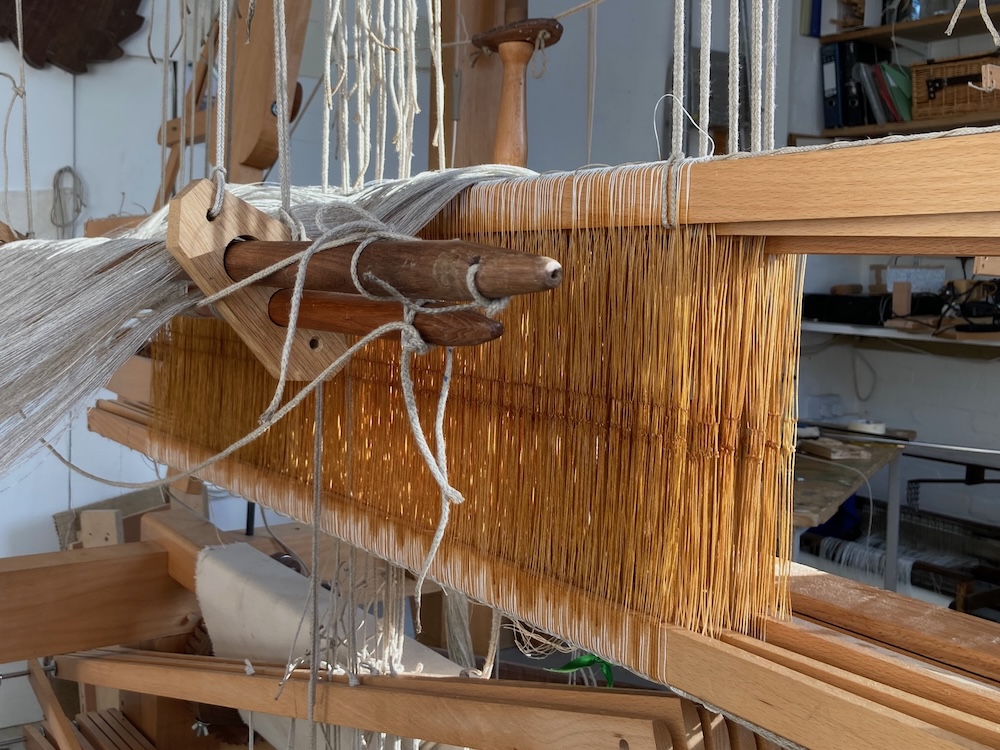
In the meantime, the photographs and film below show the process of making my first set of heddles in October 2024. I made them for weaving a copy of huckaback towelling made in Norfolk c. 1900, with a patterned barley corn weave, woven on six leaves, each with a different number of heddles. I coated the heddles with shellac varnish (french polish) to make them more resilient.
The photographs show the making, varnishing, threading and use of the heddles in the loom.
.
.
.
.
.
.
.
.
.
.
.

.
.
.
Notes:
- It wasn’t until it came to writing this post that I noticed something unusual about the heddles on the loom at Ballyduggan Cottage: each shaft appears to carry two rows of heddles, one along the front and a second along the back. I have not seen this elsewhere, but my guess is that it was done to ease congestion. They were used for weaving quite fine tabby on four leaves, working in pairs, and the double rows of heddles would distribute the requisite number of heddles in eight rows rather than four, easing congestion when the sheds are opened and the warp rises or sinks between the heddles. Clever! ↩︎
Appendix
The following is the full description of the heddle making process from Luther Hooper (1920) Hand-Loom Weaving Plain & Ornamental, pp 109-110. He uses the term leash to refer to a single heddle and the term headle to refer to a collection of leashes:
“The knitted and spaced leashes for fine weaving have to be made on a frame prepared for the purpose (fg. 50). It is constructed as follows: Two strong laths, A, A, four inches wide by half an inch thick, and at least three feet long, are neatly mortised into two thick end-pieces, B, B, so as to form an oblong frame not less than fourteen inches wide. The corners are not permanently fixed, but are held together by movable pegs.
A wooden lath or brass rod crosses the frame, from end to end, passing through the end-pieces rather nearer to one lath than the other. The diameter of the rod or lath is determined by the size of the eyes the leashes are required to have. Both laths, A, A, are marked out in inches from one end to the other. This is for the spacing of the leashes, so many to the inch. The harness thread, which is made specially strong for the purpose, is wound upon a small mesh, such as is used for the making of string nets.
The leashes are knotted to a strong, thin cord, which is tied and wound several times round one end of each lath and tightly stretched along the outer edge of the frame to the other end, where it is also wound and tied. As in the case of the separate leashes, the small loops of the continuous leashes are made first. The thread must be double-knotted to the cord by means of the mesh at the place where the headle is to begin. The mesh must then be passed round the brass rod, underneath the lath, and the thread again tied to the cord. Another loop is made in the same manner without severing the thread, and so on until the right number are made to the first inch. These being adjusted, the second inch can be made in the same way, and so on till the complete number required has been reached. In the drawing the loops are shown loose in order that their interlacement may be indicated, but they must actually be just tight enough to lie straight on the frame without bending the rod. The thread for the double loops must be tied at the beginning to the opposite lath in the same way as for the single ones. The mesh must then be passed under the frame and brought up through the opposite loop, over the rod, and, usually, double-knotted close by it; then, being brought over the lath, it must be knotted at the place it started from. The first leash will now be complete, and all the others must be finished in the same way. The eyes of the leashes for silk-weaving are not always double-knotted; many weavers prefer single knots as being less bulky. Single knots are, however, especially when the harness is new, very apt to slip out of place and give trouble. When finished the centre rod is drawn out of the frame, the pegs removed from the corners, and the collection of leashes thus freed is tied, by the cord to which they are knotted, to the laths of the headle.“