All posts by maxinbalham

Handmade Clasped Heddles from Lopham in Norfolk (Part 2)

Experimental working reconstruction of linen weaving ‘gear’ from North Lopham, Norfolk, c. 1920.

This post describes my project to make a working reconstruction of some clasped heddles from Lopham in Norfolk. It follows on from Handmade Clasped Heddles from Lopham in Norfolk (Part 1) in which I gave a detailed description of the original gear. The project was generously supported by the Association for Industrial Archaeology. This post is an edited version of an article written for association’s newsletter.
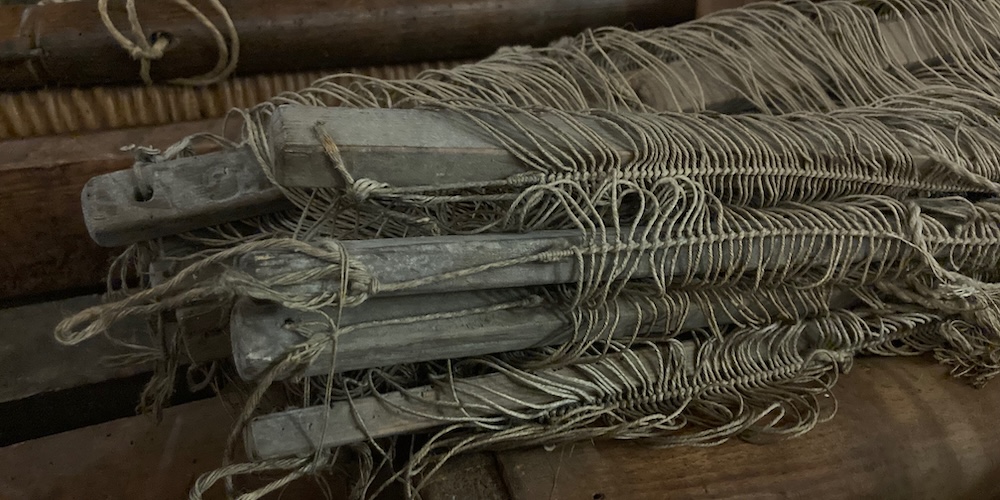
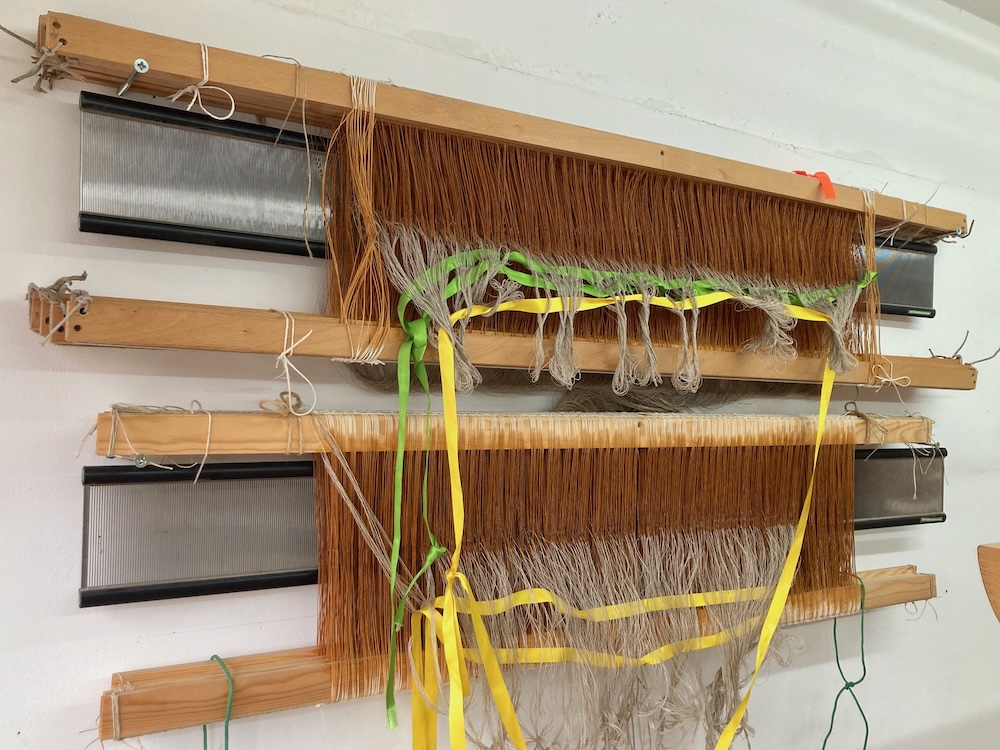
Linen weaver’s gear found at Gressenhall Farm & Workhouse in 2024. ©Max Mosscrop

This project involved the working reconstruction of a set of weaver’s ‘gear’ with handmade clasped heddles used for weaving huckaback linen in Norfolk around 1920. It began following the discovery of the gear amongst artefacts from the linen weaving villages of North & South Lopham in storage at Gressenhall Farm & Workhouse in 2024 and provided an opportunity to further my interest in the lost skills of heddle making. What are the advantages and drawbacks of clasped heddles, once widely used in the weaving industry but now obsolete in craft practice?
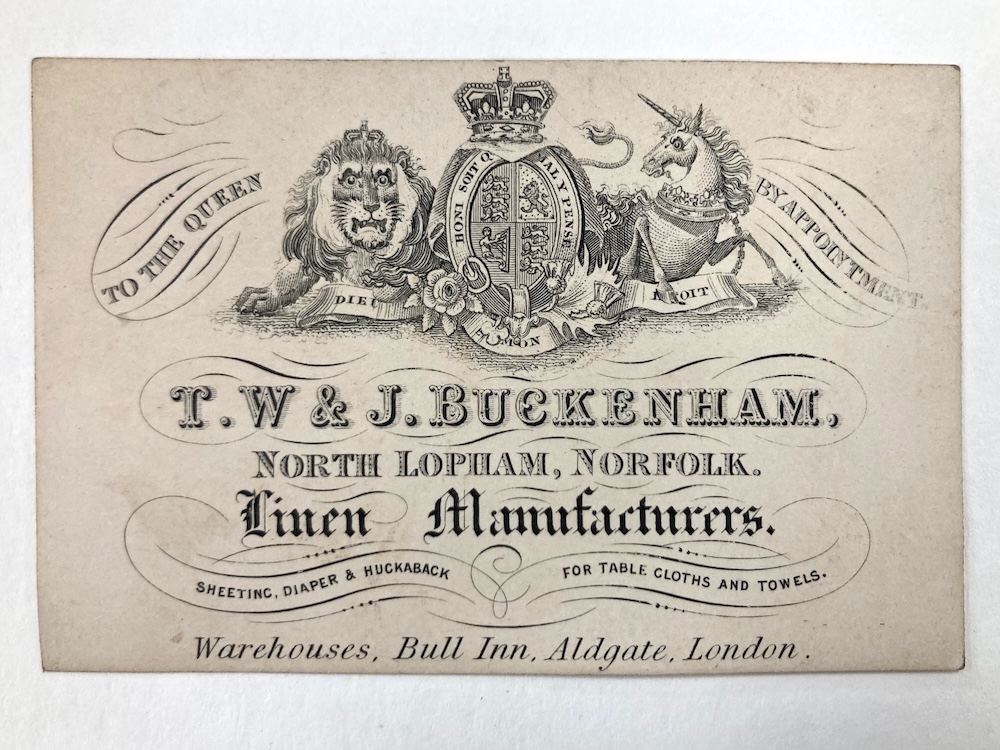
Business card of T. W. & J. Buckenham; from the papers of Rita & Percy Beales at the Crafts Study Centre, University for Creative Arts, Farham.

The villages of North and South Lopham were a centre for linen weaving during the eighteenth and nineteenth centuries. The firm of T. W. & J. Buckenham acquired the Royal Warrant as suppliers of Diaper and Huckaback Table Cloths to Queen Victoria in 1837. The industry survived until 1925 by manufacturing high-quality linen for prestigious clients including the Royal Household, City Livery Companies and aristocracy. Material evidence of this lost industrial tradition survives in the form of woven linen and equipment in the collection of Norfolk Museums Service. 1

Before the introduction of mass-produced wire or polyester heddles, handweavers used string heddles tailor-made by the weavers or professional heddle makers. The reed, heddles and shafts were collectively referred to as ‘gear’. The survival of such gear – both fragile and easily lost – is rare.

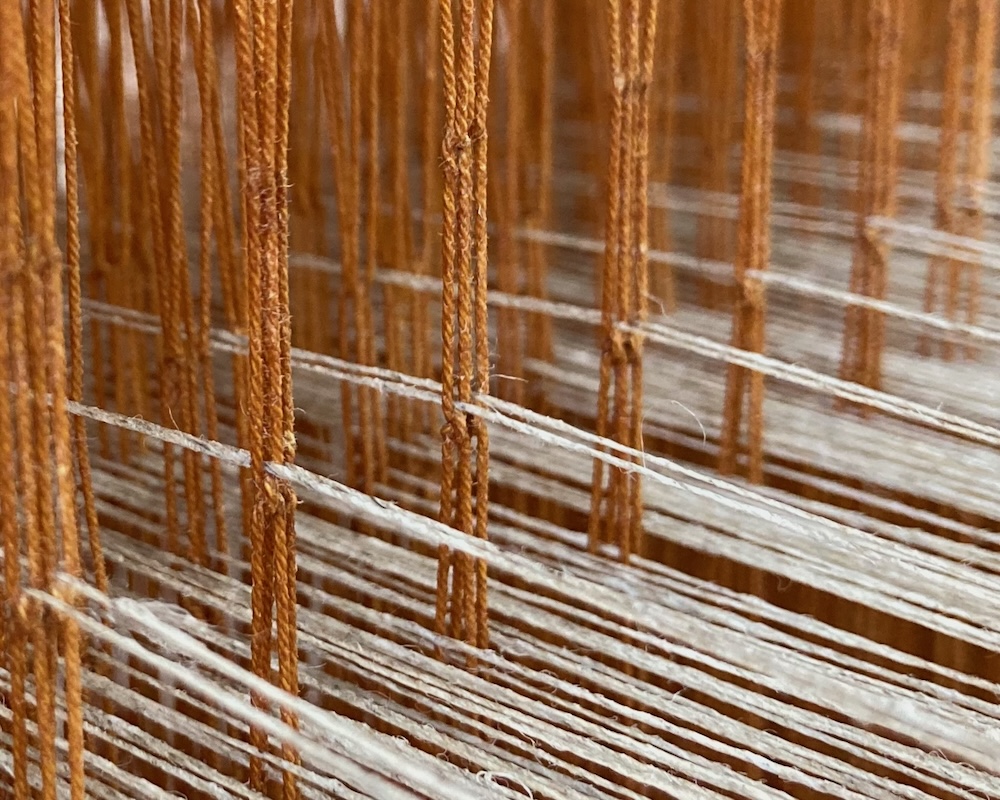
Detail of the Gressenhall gear showing clasped heddle threaded with linen warp yarn. ©Max Mosscrop

The gear found at Gressenhall contains unusual ‘clasped’ heddles. Instead of passing through an eyelet, the warp yarn is pinched in the intersection between upper and lower ‘doups’. Clasped heddles were described in early nineteenth century textbooks but seem to be unknown in contemporary weaving in the UK. 2

Linen weaver’s gear in cradle for inspection at Gressenhall Farm & Workhouse in 2024. ©Max Mosscrop

Following an initial visit to Gressenhall I designed and built a cradle to support the gear to facilitate a full inspection. I gathered information about sett, reed sleying, drafting, and heddle construction, allowing me to make a replica set of heddles for the working reconstruction. 3
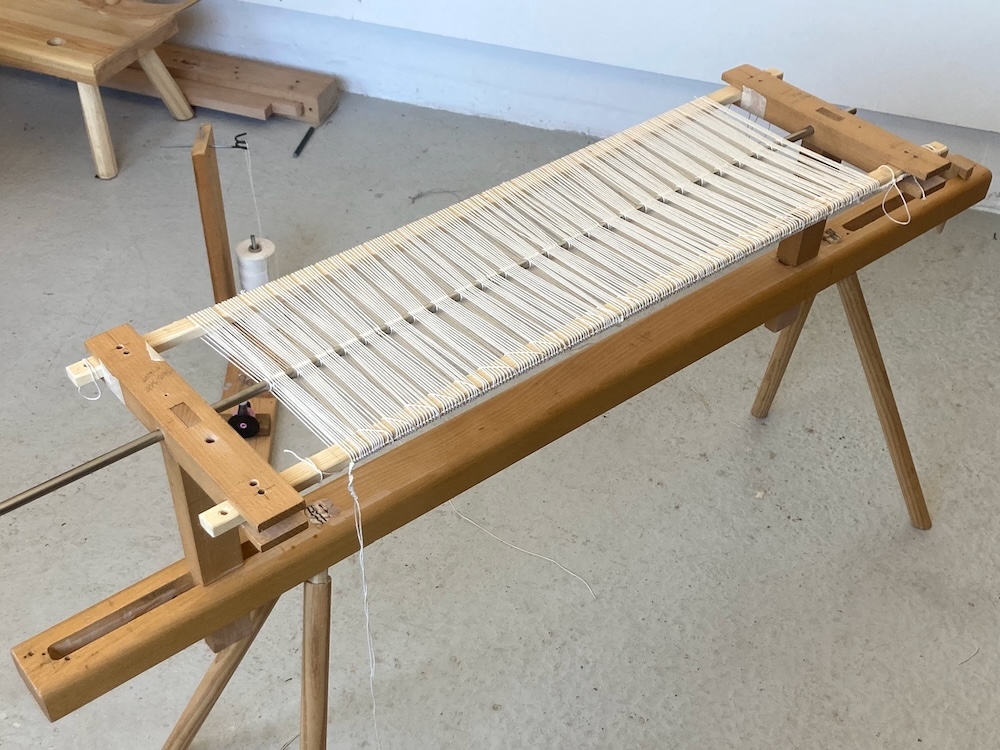
My heddle-horse in use at the studio. ©Max Mosscrop

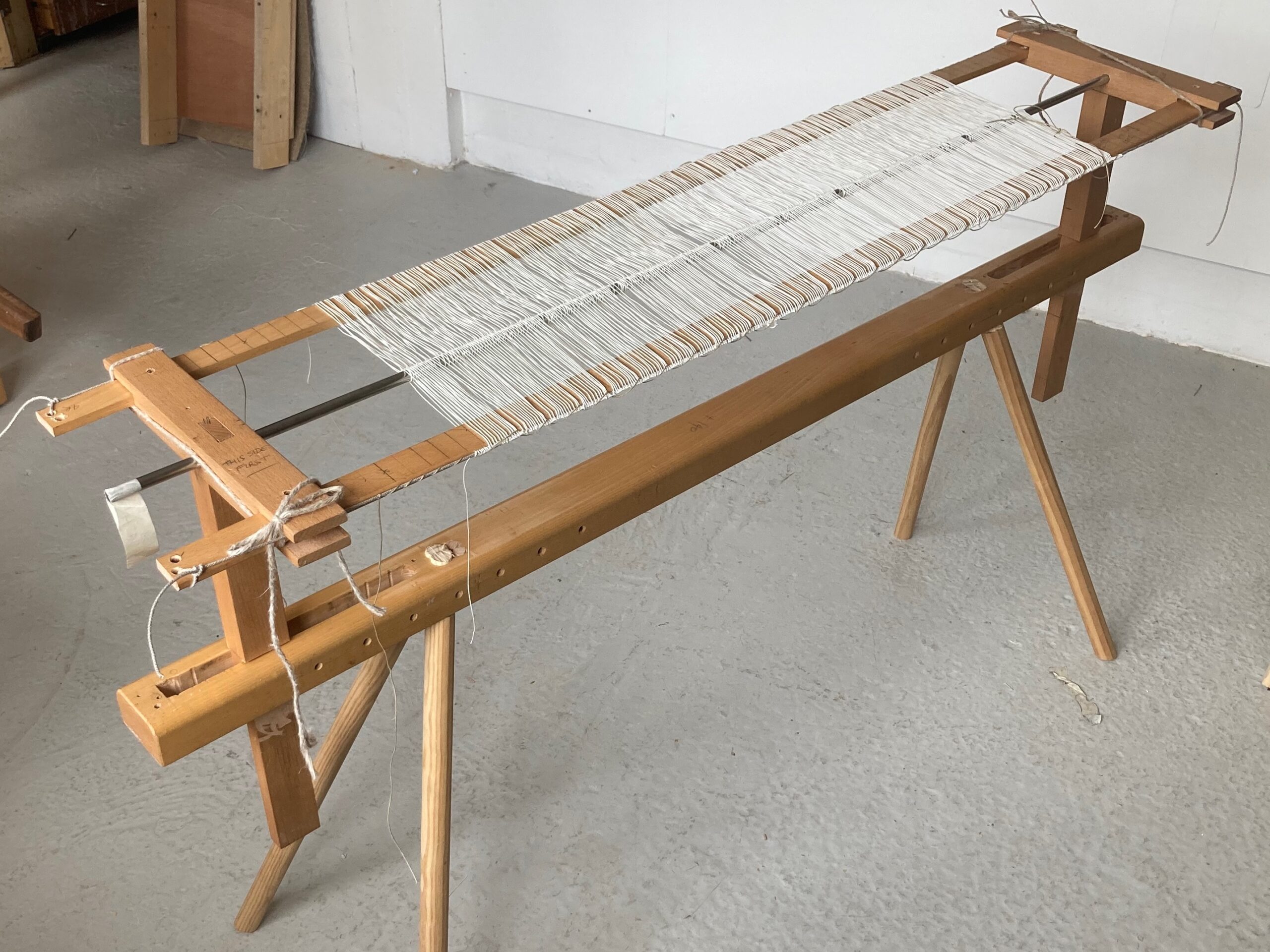
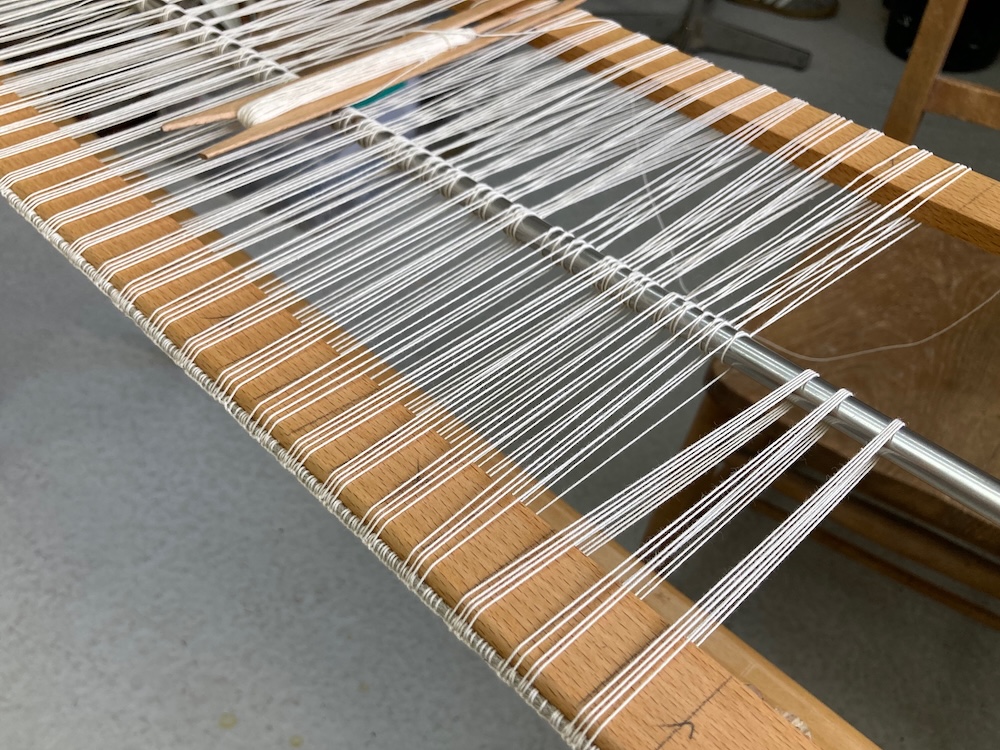
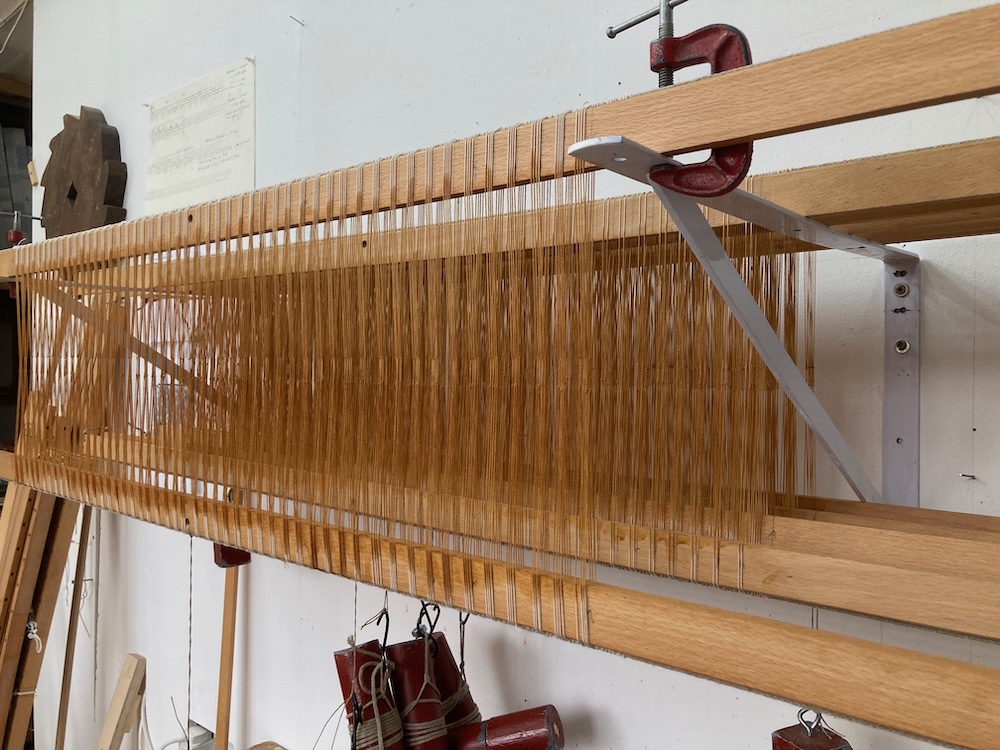
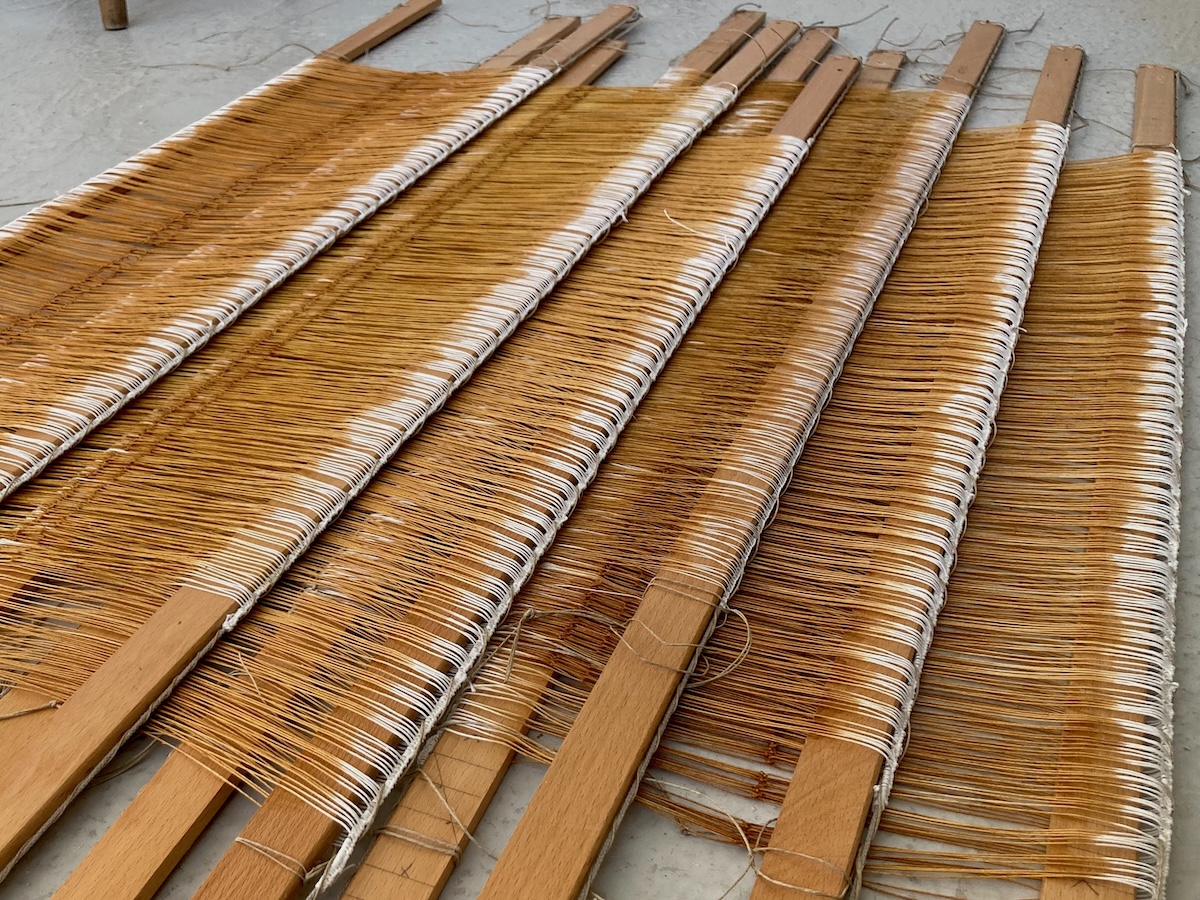
I had begun learning to make heddles in 2024 and had built a heddle-horse, based on historic examples, to do so. I used this, with some adjustments, to replicate the Gressenhall gear. Heddles are tied directly onto a pair of wooden shafts, with the shafts secured in the jig, one complete leaf of heddles being made at time. In this case there are four leaves, with a total of 900 heddles.
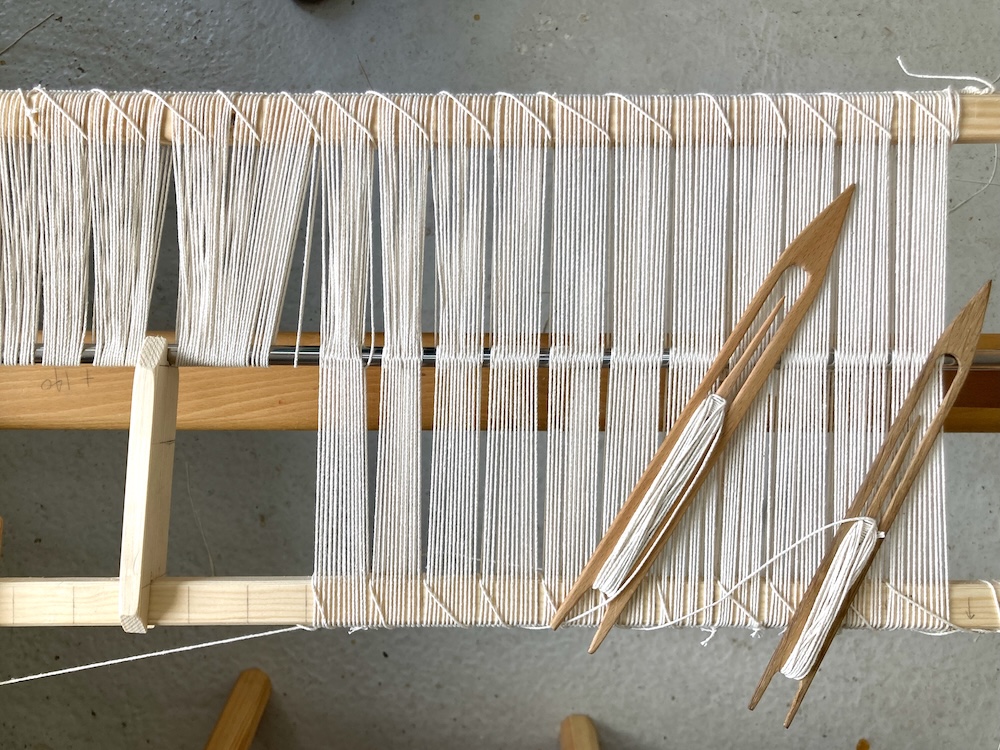
Making clasped heddles. ©Max Mosscrop

A netting needle loaded with suitable twine 4 is passed around one shaft and the central rod to make a series of ‘doups’, first along one side and then along the other, the second set intersecting with the first. Each doup is individually knotted onto cords running the length of the shaft. Having no ‘eye’, clasped heddles are slightly quicker and easier to tie than conventional heddles.
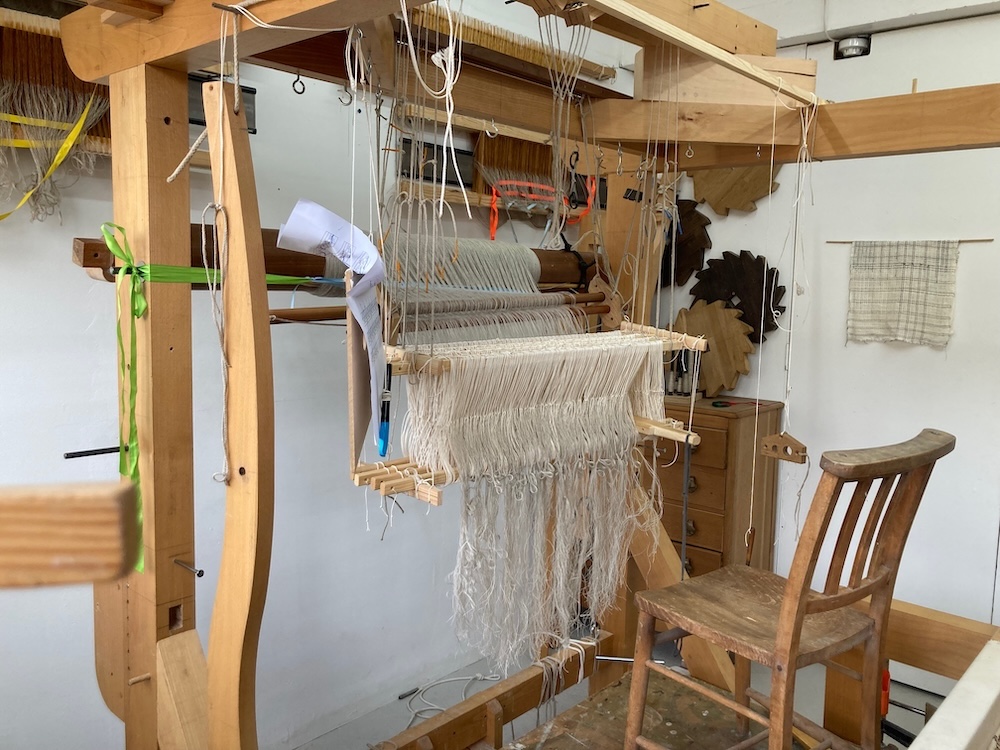
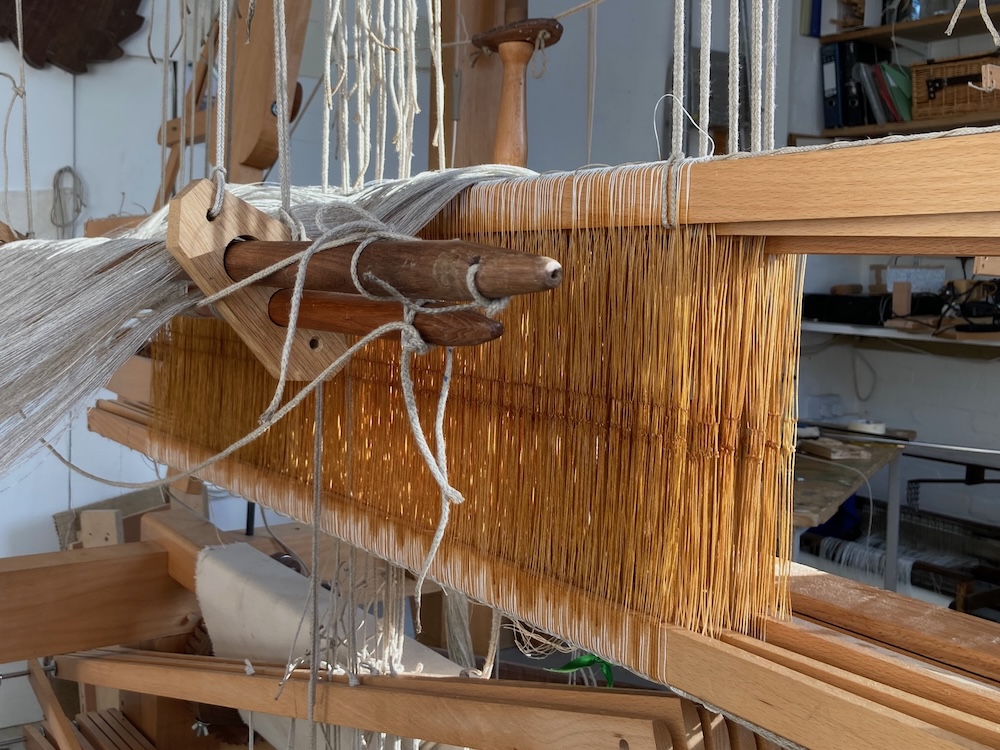
The reconstructed gear mounted in the loom for threading. ©Max Mosscrop

Once completed, the heddles were mounted in my loom for threading the warp. My loom is handmade specifically for weaving linen, modelled on museum examples of Irish linen looms. There is no record of the loom in which the Gressenhall gear was used, but other surviving Lopham looms broadly follow the Irish pattern. 5
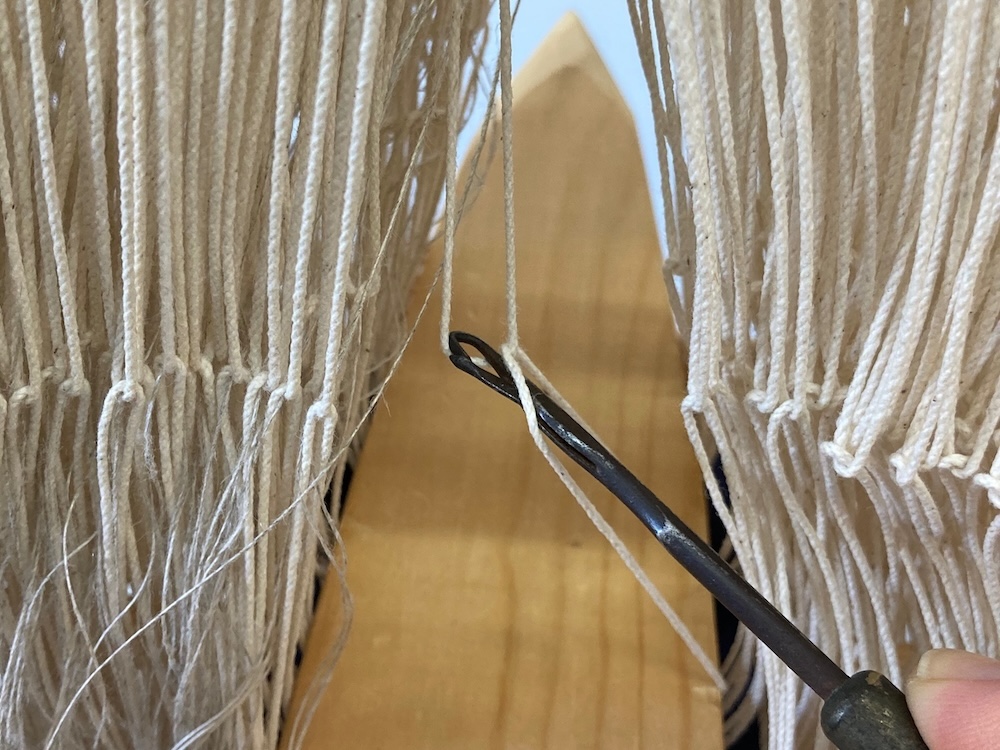
Using a latched threading hook to thread warp yarn through clasped heddle. ©Max Mosscrop

I found the clasped heddles slightly slower to thread than conventional heddles, requiring a double movement with a latched threading hook to coax the warp yarn through both lower and upper doups. Although threading is laborious it was customary to do this only once, tying-on subsequent warps to the thrums of the old.
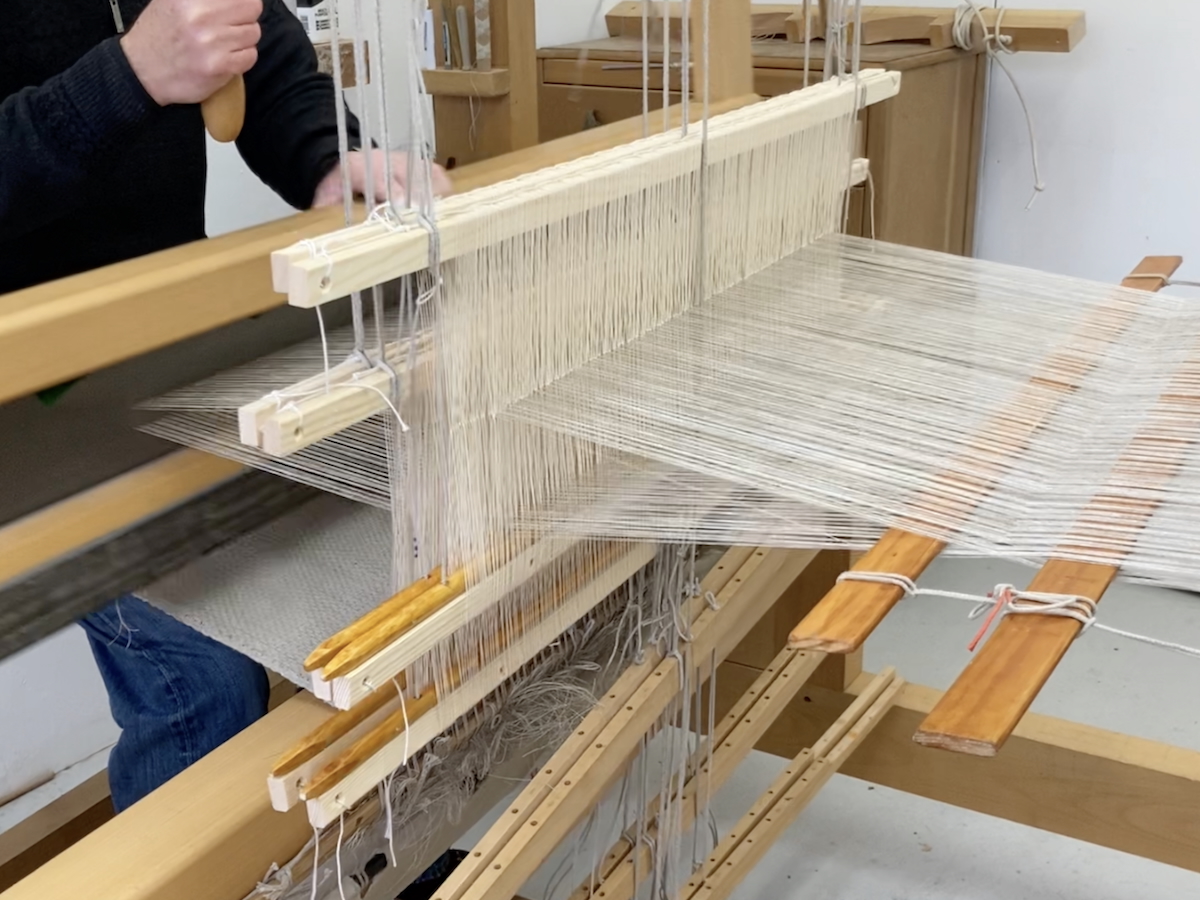
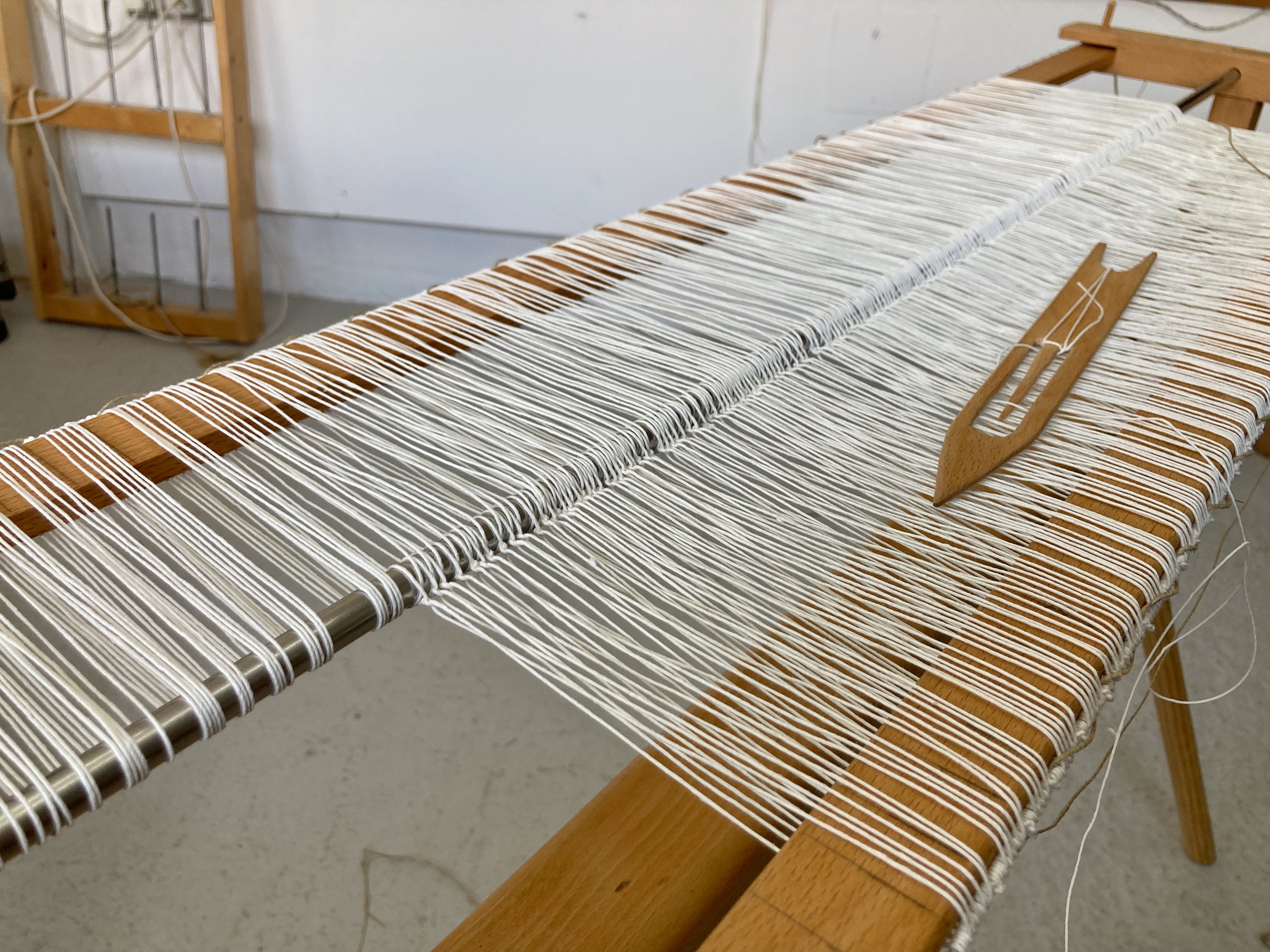
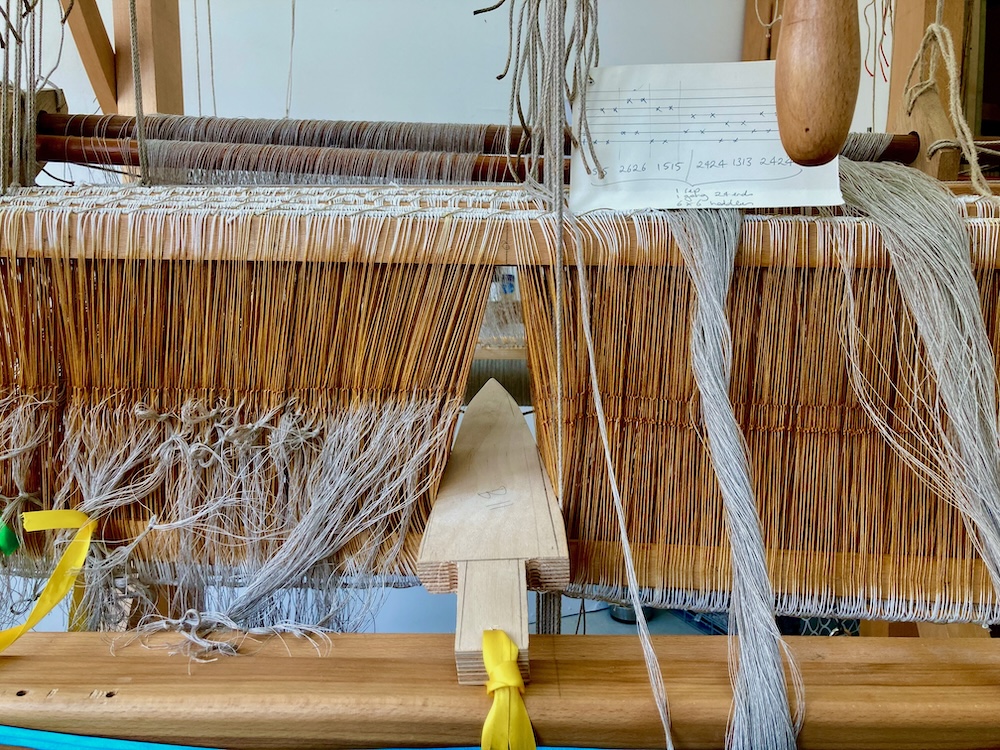
After threading, I prepared the loom for weaving, with the new gear tied up to four treadles for weaving huckaback. It was obvious from the outset that clasped heddles would pinch or clasp the warp yarn during weaving. This is described in Murphy, John (1827)Treatise on the Art of Weaving as an advantage when working with “weak or soft” yarns. 6 The linen yarn I usually work with is neither weak or soft, but I wondered if the use of clasped heddles would affect the interlacement of warp and weft or change how the weft was beaten up in the web. I have woven huckaback many times, on this same loom and with the same yarn. I suspect the clasped heddles helped produce a slightly higher pick density, but further experimentation is needed to confirm this. Otherwise, I could see no significant difference in cloth woven with the clasped heddles.

I did, however, encounter an unexpected problem. As weaving progresses the warp must be advanced through the heddles periodically. I had not anticipated the extent to which the pinching of the clasped heddles would impede this. Although a single warp thread could be pulled through its heddle under moderate tension, the force required to pull 900 threads through the heddles was considerable, causing distress to the warp and upsetting the heddle alignment.

I eventually found a solution in the form of a mechanism for slackening the heddles while maintaining their alignment, described in an overlooked passage and illustration in Murphy’s Treatise. The device, which I was able to reconstruct in the loom, consists of rods inserted through the lower doups of the heddles and connected by cords and pulleys to a handle. Pulling down on the handle raises the rods, slackens the heddles and allows the heddles to be easily nudged back along the warp. As far as I am aware this device is unknown in contemporary craft weaving.
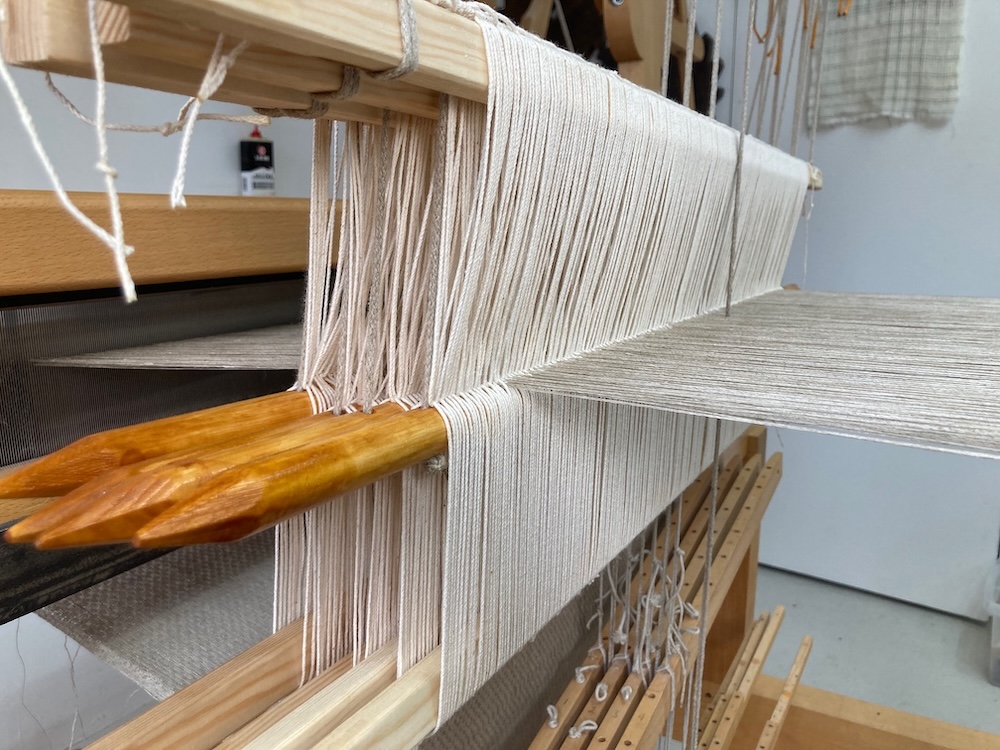
Detail showing Murphy’s rods in raised position to slacken heddles to help warp advancement. ©Max Mosscrop

Once I had solved this problem the weaving proceeded smoothly and I was able to make a satisfactory length of huckaback linen comparable in quality to examples in the Norfolk museum collection.
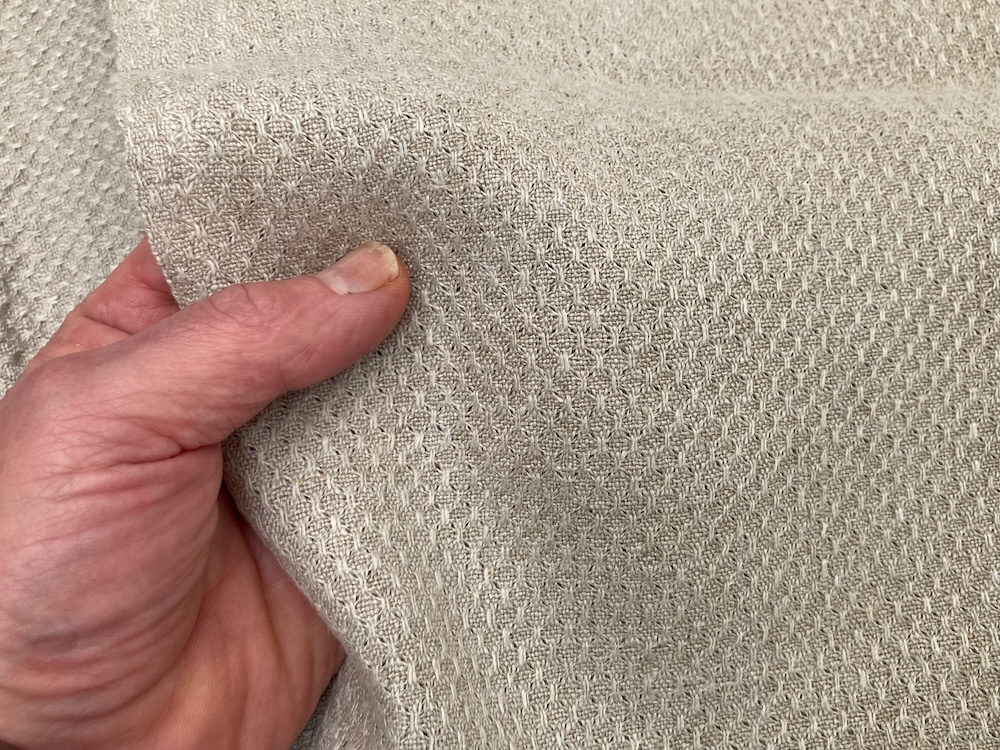
Huckback linen towelling made with the reconstructed gear. ©Max Mosscrop

The project has so far uncovered no clear advantage to the clasped heddles for weaving linen, beyond their initial ease of construction and my speculations about pick density. The question of why they were used in Lopham remains unanswered. A more definite finding relates to the unexpected extent to which clasped heddles impede the advancing of the warp, and the resulting re-evaluation of a mechanism for resolving this as described in John Murphy’s Treatise of 1827.
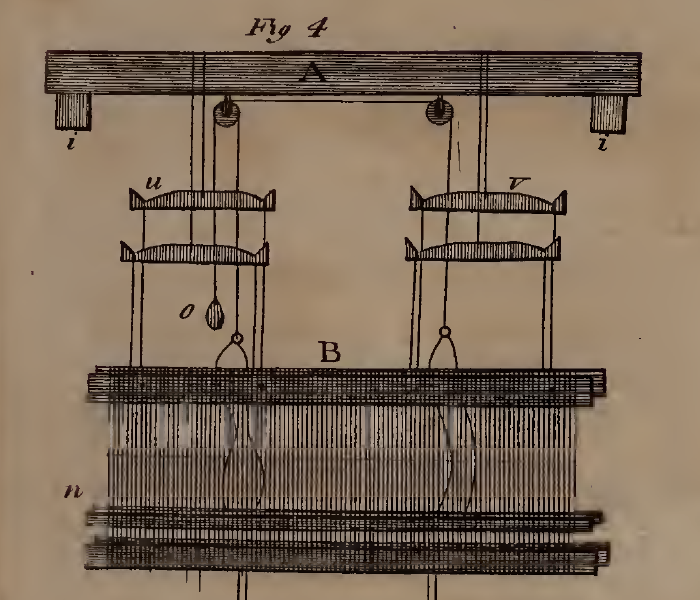
Detail of illustration in Murphy. J. (1827) Treatise on the Art of Weaving, showing the mechanism for slackening the heddles, rods (n) raised by by pulling down handle (o).

Notes:

  1. For more about the Lopham linen industry: https://www.maxmosscrop.com/blog/lopham-linen/ ↩︎
  2. Clasped heddles are described in both Duncan, J. (1808) Practical and Descriptive Essays on the Art of Weaving; and Murphy, J. (1827) Treatise on the Art of Weaving. ↩︎
  3. For a detailed description see: https://www.maxmosscrop.com/blogs-2025/handmade-clasped-heddles/ ↩︎
  4. I used NM 20/6 cotton warp yarn, having first tried 20/9 and finding it too heavy, causing congestion between heddles and warp. ↩︎
  5. see for example my post about the loom in Bankfield Museum, Halifax: https://www.maxmosscrop.com/blogs-2023/lopham-looms-the-bankfield-loom/ ↩︎
  6. Murphy. p. 2. “Should the yarn be weak or soft in the undressed state, the clasps, when drawn together, prevent it, in a considerable degree, from being unequally strained behind the mounting.” ↩︎
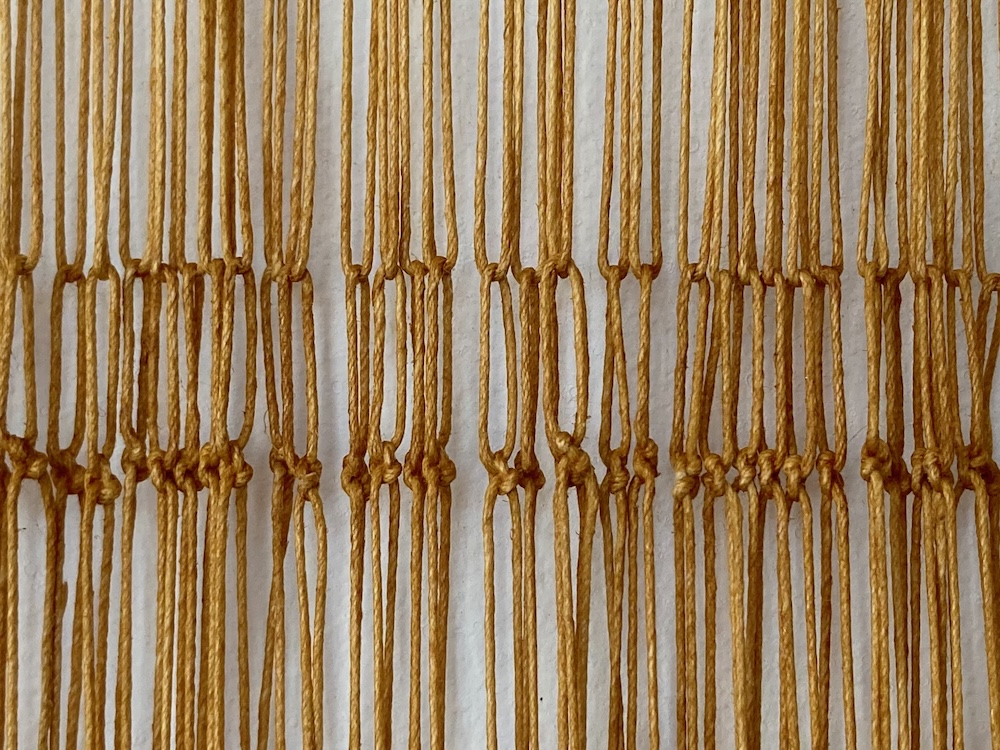
Heddle making

.

Handmade heddles, 2024 ©Max Mosscrop

.

The simple heddle is central to all handloom weaving and deserving of attention. Modern handlooms are usually fitted with mass-produced polyester or wire heddles, but the making of bespoke string heddles was once a craft in its own right, practised by both weavers and specialist heddle makers. For the last couple of years heddle making has been intrinsic to my practice and part of my mission to recover and preserve traditional weaving skills.

In this post I look at some old heddles and share some photographs of my first attempt at heddle making in 2024.

.

previous arrowprevious arrow
next arrownext arrow
 

.

The photographs above show three sets of old string heddles. The first belongs to a nineteenth century loom at the Ballyduggan Weavers’ Cottage at the Ulster Folk Museum in Cultra, Northern Ireland. They are a fairly typical set of old heddles: apparently hand-knitted and bespoke, each heddle knotted to cords running along top and bottom shafts and therefore having a fixed sett. These are coated in varnish to make them more resilient. 1 The second photograph shows a detail of one of twenty leaves of heddles used to weave damask diaper at Bankfield Museum in Halifax made by a specialist heddle maker in 1958 (you can read more about these heddles here). The third & fourth photographs show a set of unusual ‘clasped’ heddles used for weaving linen in Norfolk (which you can read more about here).

Each set of heddles was made for weaving a specific cloth. This specificity is a key characteristic of old string heddles and a contrast to the flexibility of modern heddles. The number and spacing of the heddles along the shaft were fixed to correspond with a certain sett and weave structure. If a loom was to be used to weave a different fabric the heddles would be removed and stored, with the reed, and usually still threaded with the remnant or ‘thrums’ of the previous warp. This whole apparatus of heddles, shafts, reed and thrums was referred to as ‘gear’. Although it takes time to make a set of heddles, time is also saved by tying-on a new warp to an existing set of gear rather than re-threading the heddles.

.

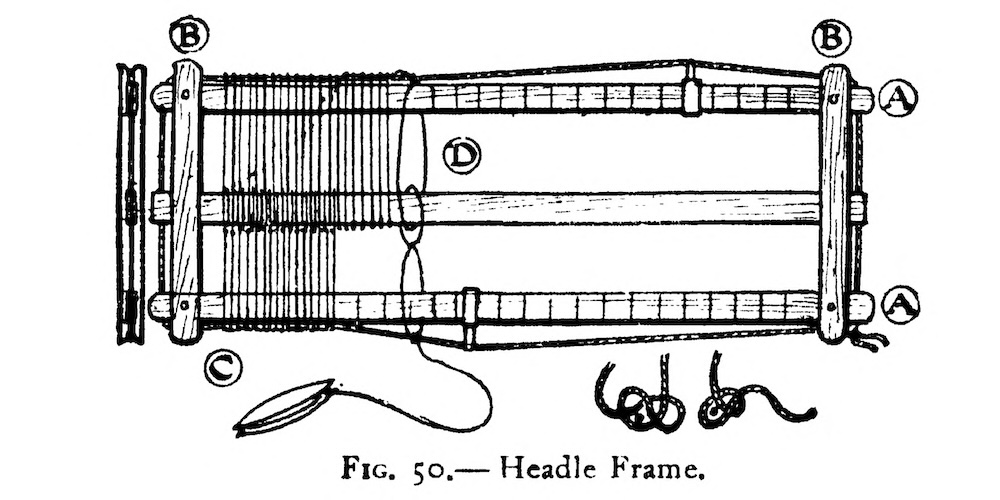
A frame for heddle making is shown above in an illustration from Luther Hooper’s Hand-Loom Weaving Plain & Ornamental (1920) where it is accompanied by a good desription of the basic principles of heddle making, which I quote in full at the bottom of this post.

I first learnt to make heddles by watching the weaver Justin Squizzero at the Marshfield School of Weaving in Vermont. The frame I use is roughly copied from Justin’s antique heddle frame, with the shafts and heddles held horizontally at a convenient height for working seated.

At the time of writing I have made five sets of heddles and still consider myself a novice. It is not my intention here to give a step-by-step guide to the process, although I may try that once I am more confident in my method.

In the meantime, the photographs and film below show the process of making my first set of heddles in October 2024. I made them for weaving a copy of huckaback towelling made in Norfolk c. 1900, with a patterned barley corn weave, woven on six leaves, each with a different number of heddles. I coated the heddles with shellac varnish (french polish) to make them more resilient.

The photographs show the making, varnishing, threading and use of the heddles in the loom.

.

.

©Max Mosscrop 2026

.

©Max Mosscrop 2026

.

©Max Mosscrop 2026

.

.

©Max Mosscrop 2026

.

©Max Mosscrop 2026

.

©Max Mosscrop 2026

.

©Max Mosscrop 2026

.

©Max Mosscrop 2026

.

©Max Mosscrop 2026

.

©Max Mosscrop 2026

.

©Max Mosscrop 2026

.

Notes:

  1. It wasn’t until it came to writing this post that I noticed something unusual about the heddles on the loom at Ballyduggan Cottage: each shaft appears to carry two rows of heddles, one along the front and a second along the back. I have not seen this elsewhere, but my guess is that it was done to ease congestion. They were used for weaving quite fine tabby on four leaves, working in pairs, and the double rows of heddles would distribute the requisite number of heddles in eight rows rather than four, easing congestion when the sheds are opened and the warp rises or sinks between the heddles. Clever! ↩︎

Appendix

The following is the full description of the heddle making process from Luther Hooper (1920) Hand-Loom Weaving Plain & Ornamental, pp 109-110. He uses the term leash to refer to a single heddle and the term headle to refer to a collection of leashes:

The knitted and spaced leashes for fine weaving have to be made on a frame prepared for the purpose (fg. 50). It is constructed as follows: Two strong laths, A, A, four inches wide by half an inch thick, and at least three feet long, are neatly mortised into two thick end-pieces, B, B, so as to form an oblong frame not less than fourteen inches wide. The corners are not permanently fixed, but are held together by movable pegs.

A wooden lath or brass rod crosses the frame, from end to end, passing through the end-pieces rather nearer to one lath than the other. The diameter of the rod or lath is determined by the size of the eyes the leashes are required to have. Both laths, A, A, are marked out in inches from one end to the other. This is for the spacing of the leashes, so many to the inch. The harness thread, which is made specially strong for the purpose, is wound upon a small mesh, such as is used for the making of string nets.

The leashes are knotted to a strong, thin cord, which is tied and wound several times round one end of each lath and tightly stretched along the outer edge of the frame to the other end, where it is also wound and tied. As in the case of the separate leashes, the small loops of the continuous leashes are made first. The thread must be double-knotted to the cord by means of the mesh at the place where the headle is to begin. The mesh must then be passed round the brass rod, underneath the lath, and the thread again tied to the cord. Another loop is made in the same manner without severing the thread, and so on until the right number are made to the first inch. These being adjusted, the second inch can be made in the same way, and so on till the complete number required has been reached. In the drawing the loops are shown loose in order that their interlacement may be indicated, but they must actually be just tight enough to lie straight on the frame without bending the rod. The thread for the double loops must be tied at the beginning to the opposite lath in the same way as for the single ones. The mesh must then be passed under the frame and brought up through the opposite loop, over the rod, and, usually, double-knotted close by it; then, being brought over the lath, it must be knotted at the place it started from. The first leash will now be complete, and all the others must be finished in the same way. The eyes of the leashes for silk-weaving are not always double-knotted; many weavers prefer single knots as being less bulky. Single knots are, however, especially when the harness is new, very apt to slip out of place and give trouble. When finished the centre rod is drawn out of the frame, the pegs removed from the corners, and the collection of leashes thus freed is tied, by the cord to which they are knotted, to the laths of the headle.

Old Weaver’s Temples

previous arrowprevious arrow
next arrownext arrow
 

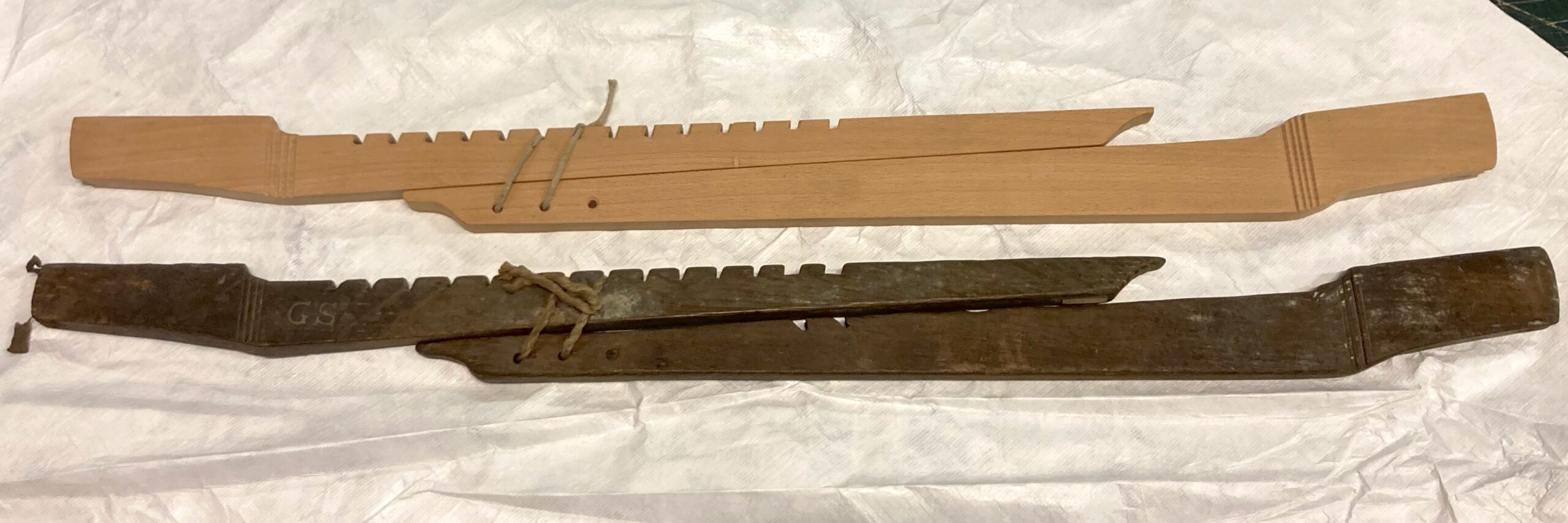
The photographs above show a pair of old weaver’s temples, found last year in the museum stores at Gressenhall Farm & Workhouse in Norfolk. They were amongst a largely uncatalogued collection of artefacts from the linen weaving village of North Lopham, and were tangled in the harness of a dismantled jacquard loom.

Nowadays, handloom weavers tend to use the singular form – a temple – to name the device used to stretch the cloth across the loom as it is woven, but historically the plural form temples was more usual. The name derives from the Latin templa, meaning wooden planks or beams. There is a good description in John Duncan’s Practical and Descriptive Eassays on the Art of Weaving (1808):

The temples, by means of which the cloth is kept extended during the operation, consist of two pieces of hard wood with small sharp points in their ends, which lay hold of the edge, or selvage, of the cloth at either side. These pieces are connected by a cord, passing obliquely through holes, or notches, in each piece. By this cord, they can be lengthened or shortened, according to the breadth of the web.

.

The film above, a short extract from Bäuerliche Leinenweberei 4: Herstellen von Leinwand, shows similar temples in use in Germany in 1978/9. 1

.

.

For me the beauty of these old temples lies in their mixture of simplicity and nuance: two subtly shaped pieces of wood joined by a length of cord which is simultaneously a hinge and a means of adjustment. I had been on the lookout for an old set to copy and use, so I was delighted at finding this pair from Norfolk. The photograph above shows my version next to the original. They are a little too large for the towelling I have been weaving recently, so I also made a smaller pair, shown below in use weaving a nine-end huckaback.

previous arrowprevious arrow
next arrownext arrow
 

.


The temples found at Gressenhall are carved with the monogram “GS”. There are no weavers with these initials mentioned in the Buckenham ledger or in the list of “Old Weavers of North Lopham of Years Ago” collected by Rita and Percy Beales in the 1920’s. But perhaps the temples once belonged to George Shaw, one of the “happy and sociable” Lopham weaving masters who met with James Mitchell, the Parliamentary Commissioner investigating the plight of handloom weavers, in the village pub in 1839. 2

Notes

  1. The fourth in a series of documantary films recording the re-enactment of traditional linen weaving in the town of Dickenshied in 1978/9, produced by Landschaftsverband Rheinland. See my blog for more. ↩︎
  2. See this blog for more about the Report of the Parliamentary Commission on Hand-Loom Weavers (1840). ↩︎

Time machine: a working reconstruction of a Norfolk bobbin winder

Earlier this year I made a working copy of an old bobbin winder that once belonged to the linen weavers of Lopham in Norfolk. The winder was gifted to Thetford Museum in 1926 by Albert Tyler, the last of the Lopham weavers, and is now in the collection of Norfolk Museums at Gressenhall. This post includes photographs of the old and new winders, with some notes on how this simple wooden machine can transport me back in time.

.

previous arrowprevious arrow
next arrownext arrow
 

.

The photographs above show my recently finished bobbin winder, the old winder on which it is modelled, and the process of making the new one. I am grateful to the curators at Norfolk Museums Service for giving me access to take photographs and measurements of the winder.

I first noticed the old winder on a visit to Gressenhall Farm & Workhouse / Museum of Norfolk Life in 2022. It was only much later, when I recognized the winder in an old photograph in the same collection, that I realized its significance. The photograph (below) shows Louise Ellen Bale and Albert Tyler using the winder outside The Limes in North Lopham around 1915 or 1920. Ellen Bale had inheritied the linen business of T. W. & J. Buckenham from her sister, Georgiana Buckenham in 1905. 1 The Limes was the Buckenham family home, with a weaving shed at the back housing at least two Jacquard looms. Albert Tyler was one of the weavers.2 In the photograph Ellen Bale is using the winder to wind yarn onto spools. She appears to be wearing black, perhaps in mourning for her sister Elizabeth Susanna who had died in 1912. She has white feathers in her bonnet, and – in a curious reversal of roles – Albert Tyler stands behind her with a watch in his waistcoat pocket.

The Buckenham business closed in 1925 on the death of Ellen Bale. The bobbin winder was gifted to Thetford Museum by Albert Tyler the following year, eventually making its way to Gressenhall.


.

For me, as a practitioner aiming to recover forgotten techniques, old tools and machines are valuable primary source materials. They provide a physical link to the practices and techniques of the artisans who made and used them.

Traditional implements like this old bobbin winder are the outcomes of technical evolution over centuries of trial and error. Though mechanically simple they can be highly nuanced and fit for purpose. They are a form of memory, crystallising the knowledge of generations of workers. Using or reconstructing these old tools reactivites dormant knowledge. It is a form of remembering.3

My initial motivation for remaking the winder was simply to acquire a traditional bobbin winder, but the project became a double reenactment: first, as I imagined and followed the processes of the carpenter who made the original winder; and second, by using the new winder I was repeating the actions of the linen workers who used the old winder all those years ago. I found myself turning into Louise Ellen Bale, with feathers in my hat and Albert Tyler looking over my shoulder.

A working reconstruction such as this achieves something that a written description or a photograph cannot. It reproduces, in the body of anyone who uses it, the patterns of movement of those who used it before: a physical communication between the living and the dead.

.

Notes

  1. See this post for more about T. W. & J. Buckenham ↩︎
  2. See this post for more about Albert Tyler ↩︎
  3. These ideas about technical evolution and technology as externalised memory are derived from the pioneering work of palaeontologist, archaeologist and enthnologist Andre Leroi-Gourhan, e.g.: Le Geste et la Parole (1964), translated by Anna Bostock Berger as Gesture and Speech (1993). ↩︎

.

.

The Bankfield Heddles

I recently returned to Bankfield Museum in Halifax to make a detailed inspection of a set of heddles from the old loom from North Lopham that I first visited in 2023. It is an unusual loom – almost nine feet wide and fitted with a witch engine operating twenty leaves of heddles. By analysing the placement of the heddles along the shafts I have been able to work out the damask diaper block pattern they were designed to weave. I had asssumed these bespoke heddles – and therefore the pattern – dated from the time the loom was used for linen weaving in Norfolk, but it turns out they were made for the museum in 1958.

.

previous arrowprevious arrow
next arrownext arrow
 

Introduction

Heddles are known as healds in the north of England, and once upon a time as yells, all deriving from the Old English hefeld: to raise1. A collection of heddles on a frame is called a leaf, or a stave, now often a shaft. 2 They were sometimes made by the weavers themselves and were often bespoke for a specific cloth. Where old heddles survive, they can reveal information about the cloth they were used to weave. I recently started making my own heddles, hence my particular interest in historic examples (see my last post).

I first went to Halifax to look at the old linen loom from Norfolk in the stores of Bankfield Museum in 2023. I took photographs and measurements, and wrote a description of the loom in a post called Lopham Looms: the Bankfield Loom. I ended that post by speculating about what a twenty-leaf loom might have been used to make – perhaps some kind of damask diaper? 3 My recent interest in heddles prompted me to wonder if the heddles from the old loom might hold some clues about this. They were unattached to the loom, lying in a bundle underneath it, and the curator kindly arranged to bring them over the museum where I could carry out a detailed inspection, which I did in April this year. This post is a report on my findings.

.


Description & analysis

There are twenty leaves, each consisting of a pair of wooden shafts carrying string heddles. The shafts are 2 metres (75 1/4 inches) long and 6mm thick; the top shafts are 42mm deep, the bottom shafts 32mm deep. The top shafts are numbered at one end. 4

A label on the first leaf indicates the heddles were made by T. Lund & Sons of Argyll Mills, Bingley, for Halifax Corporation.5 I was surprised to learn they were made in 1958 – 33 years after the loom had been acquired by the museum. The curators have no record of why the new heddles were made. Was this part of a like-for-like renovation or a complete repurposing of the loom?

The label also provides the following specifications:

Count: 40 (the sett, in ends per inch)
Staves: 20 (A ‘stave’ is a leaf or heddle-frame)
Width: 75 ¼ inches
Depth: 14 inches
Ends: 3010
Yarn: 16/50 (the yarn from which the healds are made, which appears to be cotton, subsequently varnished).

.

previous arrowprevious arrow
next arrownext arrow
 

.

The heddles are spaced at intervals along the shafts. The knitted cords running along the top and bottom are divided into short sections of 2.5 inches (63mm) by a green thread inter-knitted at intervals. Each 2.5 inch section contains 20 knots, each of which is a potential heddle place. The heddles have been coated with an amber coloured varnish after knitting.

.


.

I marked the location of the heddles on strips of paper laid out along the shafts. It quickly became apparent that the heddle spacings on leaves 1 to 5 were identical, as were those for leaves 6-10, 11-15 and 16 – 20, suggesting that they were used to weave a damask diaper block pattern with four divisions and a 5-end satin ground weave. I am familiar with these kinds of patterns from my studies of the Thomas Jackson and Ralph Watson manuscripts from the 18th and early 19th century.

.


.

Back at the studio I arranged the strips of paper adjacent to one another in leaf order, allowing me to determine the block profile draft which is repeated seven and a half times across the full width:

.

Block profile draft (Each square represents one block comprising a 5 end and 5 pick unit of satin weave)

.

In this profile, each row represents five leaves of heddles, and each column represents five warp ends. Damask diaper patterns were generally woven ‘treadled as drawn’ where the lifting sequence reflects the warp threading sequence creating a ‘square’ pattern symmetrical along the diagonal.

.

previous arrowprevious arrow
next arrownext arrow
 

.

The first two illustrations above represent the pattern that I believe the heddles were designed to weave. The first is a weave plan for one repeat of the pattern, with 305 ends, showing the entering and lifting orders. The blocks are differentiated by a contrast of primarily warp-faced and weft-faced satin. The second illustration represents the whole width of the web with seven and a half repeats of the pattern and left and right borders, a total of 3010 ends. The third image is an example of an eighteenth century English damask diaper block pattern showing the use of contrasting warp-faced / weft-faced satin.

Conclusion

The heddles were made for Bankfield Museum in 1958, and were not, as I had hoped, original heddles from the days of Lopham linen before 1925. It would appear there was an attempt in 1958 to use the loom to weave a damask diaper patterned cloth, but we do not know why this was done or if it was successful. The 2 metre width and the presence of the two borders suggests to me that there was an intention to make tablecoth.

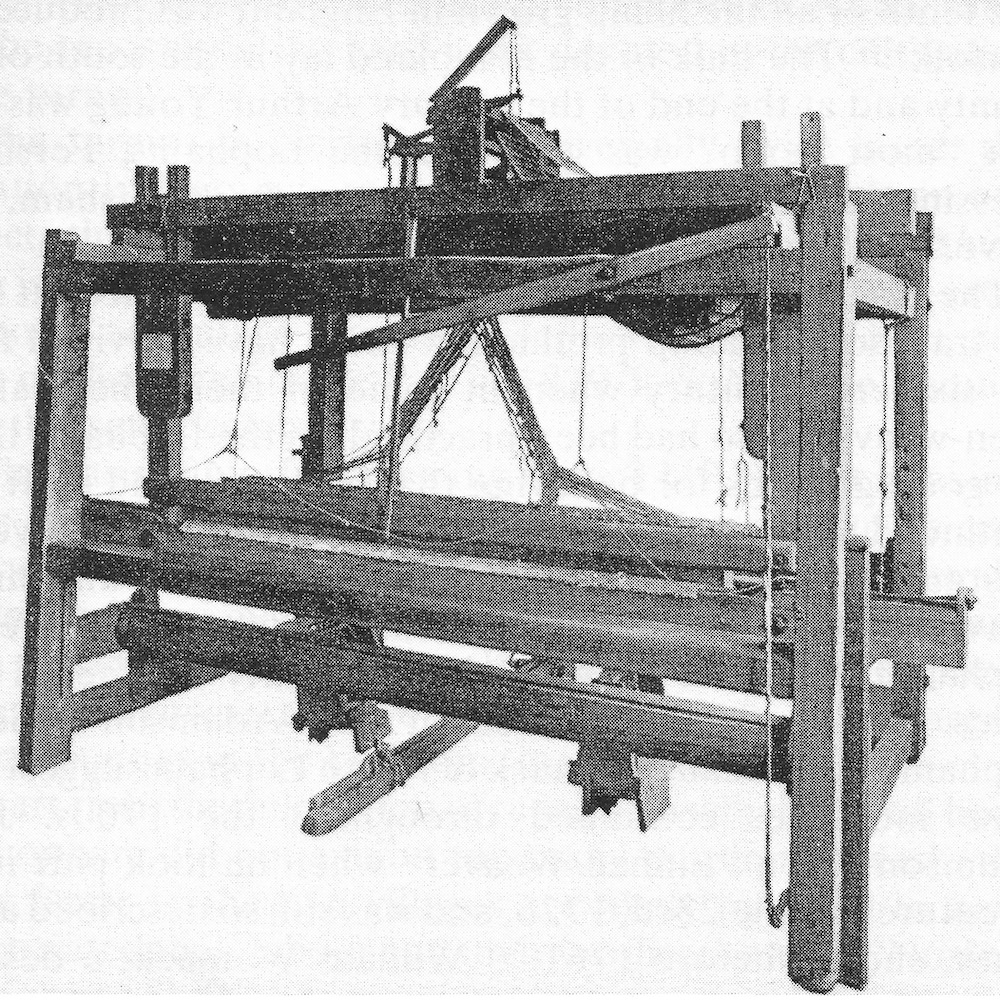
A photograph of the loom, attributed to Calderdale Museums Service, was included in Michael Friend Serpell’s A History of the Lophams (1980) – see below. It shows the loom, with the witch engine on top, and a set of heddle leaves corresponding to those I inspected, and was perhaps taken around the same time the heddles were made.

The linen weavers of North & South Lopham became known for making fine damask linen, rather than damask diaper linen. Examples of the former but not the latter survive in the collection of Norfolk Museums. However, back in 1837 Thomas Buckenham had acquired the Royal Warrant as supplier of Diaper and Huckaback Tablecloths to Queen Victoria, and we know from the Buckenham ledger that the Lopham weavers were making cloth they recorded as “diaper” in the period between 1876 and 1911. Diaper is a rather ambiguous term that has meant different things at different times and in different branches of the textile industry. It seems likely that damask diaper – of the type represented by the Bankfield heddles, and as woven by eighteenth century Yorkshire weavers Thomas Jackson and Ralph Watson – was manufactured in North & South Lopham but I know of no consclusive evidence for this.

The cloth the Bankfield heddles were designed to weave is relatively coarse at 40 ends per inch, much coarser than the damask made in Lopham before 1925. This makes me suspect that the 1958 project was a repurposing of the loom. Whether or not the 1958 damask diaper pattern is a based on linen previously made on the loom in Lopham remains an open question.

Notes

  1. Luther Hooper refers to heddles as ‘headles’ or ‘leashes’ in Hand-Loom Weaving Plain & Ornamental (1920). ↩︎
  2. The term ‘shaft’ is now most widely used, but confusedly so in my view, since shaft also refers specifically to the wooden bars. ↩︎
  3. Damask diaper: I make a distinction between damask diaper – block patterns woven with a multi-shaft loom or a shaft draw loom – and damask proper – intricately figured linen woven on Jacquard looms. ↩︎
  4. Terminology: I use the term ‘leaf‘ to refer to a single frame consisting of heddles on a pair of shafts, following 19th century writers such as John Duncan, although ‘shaft‘ is now commonly used in this sense. The makers of the Bankfield heddles used the term ‘stave‘. As a northerner I prefer healds to heddles but the latter is now more globaly recognised ↩︎
  5. The firm Lund & Sons are still in business as Lund Precision Reeds Ltd. ↩︎

Handmade Clasped Heddles from Lopham in Norfolk (Part 1)

This is an analysis of a set of weaver’s heddles used to make huckaback linen in Lopham, Norfolk, probably 1900 – 1930.

Last year (2024) I visited Norfolk Museum Services’ storage facility at Gressenhall Farm & Workhouse in search of an old loom from North Lopham. The loom was there, dismantled, the big wooden timbers piled up in a rack along with other artefacts originally from Lopham. Amongst these we found a set of weaver’s ‘gear’ from a smaller loom. Shafts, heddles and reed, still threaded with the end of a warp. The heddles are unusual eyeless or ‘clasped’ heddles. I recently returned to do a full inspection, and this post is a report about my findings. I am grateful to the curators at Gressenhall for help and patience.

( My post Handmade Clasped Heddles from Lopham in Norfolk (Part 2) describes how I subsequently made a working reconstruction of this gear in 2025)

Weaver’s gear from Lopham in Norfolk, collection of Norfolk Museums Service. ©Max Mosscrop 2025

Introduction

The photograph above shows a set of heddles and a reed still threaded with a linen warp and a remnant of woven huckaback, recently unearthed in the museum stores at Gressenhall Farm & Workhouse in Norfolk. It is unusual for heddles like this to survive, making this is a valuable find with much to tell about traditional techniques.

Lopham was the last place in England where linen was made professionally on handlooms using skills passed down from generation to generation. Albert Tyler is reputed to have carried on weaving huckaback for a few years after the closure of T. W. & J. Buckenham in 1925, 1 and to have been the last of the Lopham weavers.2 It is possible that this set of heddles and reed belonged to him, in which case these two inches of huckaback might be the last piece of ‘Lopham linen’ ever made.

Unlike modern heddles, which are mass produced from either polyester or wire, these old heddles were made of string and hand-knitted by the weavers themselves. Contemporary handweavers might think of their heddle leaves as permanent fixtures in the loom, never to be removed, but it was once common practice to keep a different set of ‘gear’ for each type of cloth. Upon finishing a length of cloth, the weaver would leave the last bit of warp threaded in the reed and heddles together with a few inches of woven web. This gear would then be bundled up and stored until the next time the same cloth was needed. The weaver would then tie a new warp onto the ends of the old warp and use that to draw the new warp through the heddles and reed, rather than re-threading. The gear effectively ‘remembers’ information about the cloth – the sett, the sleying, the drafting.

.

previous arrowprevious arrow
next arrownext arrow
 

Inspection

I built a wooden cradle to temporarily support the shafts and reed to facilitate a thorough inspection without damaging the yarn or heddles. I was able to discover information about sett, reed sleying, drafting, and details about the heddle construction.

There are 4 pairs of heddle shafts. The shafts are 94cm long, 12mm thick and 20mm high. Cords remain attached to top and bottom shafts – two single loops towards either end of what I assume to be the top shafts, and a single loop along the bottom shafts to tie to the treadles. I arranged the gear in the cradle accordingly. This suggests the huckaback cloth was woven with warp floats on the top surface, and more ends raised than lowered during weaving.

The steel reed is 78cm long and 11cm high (8cm between baulks).

.

previous arrowprevious arrow
next arrownext arrow
 

Sett, sleying, and draught

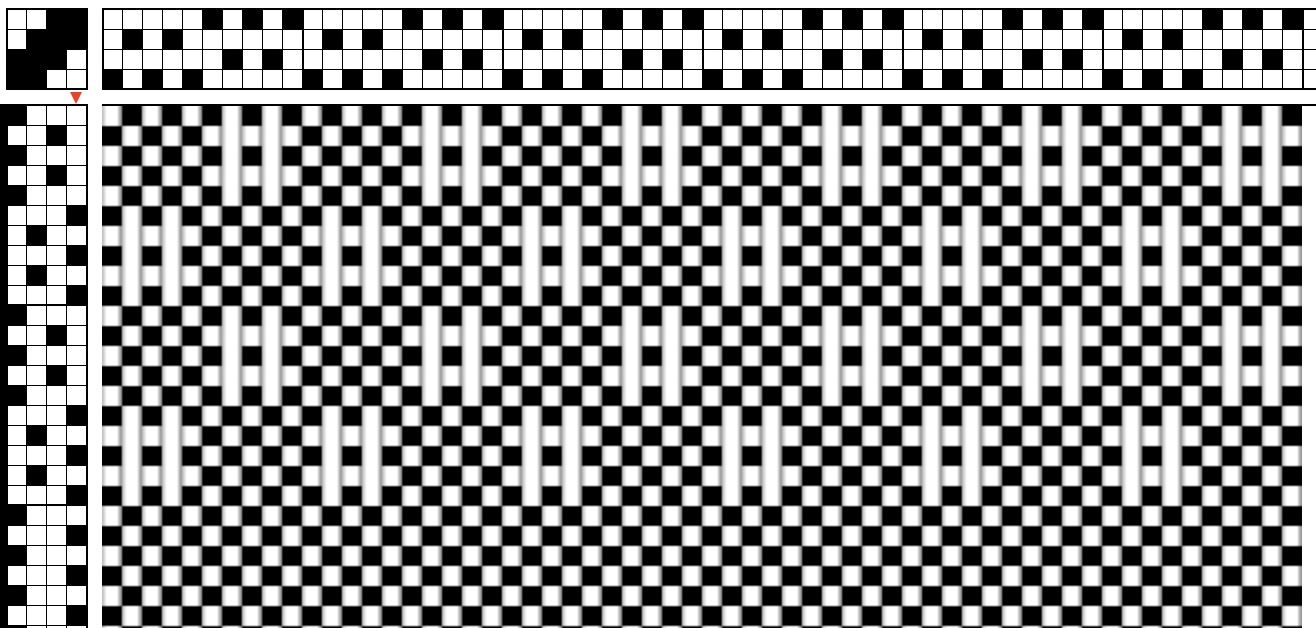
The short length of woven cloth remaining in front of the reed is standard huckaback, with 5 ends and picks in one unit. The reed has 16 dents per inch. The warp is sleyed with 2 ends per dent, giving a sett of 32 ends per inch. There are approximately 500 dents in the reed and 1000 threaded warp ends.

I followed individual warp threads from the cloth remnant through the reed and back to the heddles to determine the draft, which is like this:

According to John Tovey, this was the commercial threading for huckaback, having “the advantage of converting easily to plain weave by tying the front pairs of shafts together for plain weave, using two treadles, two lamms, and only the top pulleys on a counter-balance loom.” 3 The tie-up to give alternating left and right feet is satisfyingly neat. Here is a full drawdown:

Some threads towards the selvages are broken, but I believe this is the entering used at left and right selvages:

.

.

previous arrowprevious arrow
next arrownext arrow
 

Heddles

The heddles are particularly interesting: they are unusual eyeless or ‘clasped’ heddles, with the warp yarn caught in the intersection between upper and lower loops. These are the only clasped heddles I have ever seen in the UK, although they are mentioned in nineteenth century weaving manuals such as John Duncan’s Practical and Descriptive Essays on the Art of Weaving (1808): “For plain work, clasped heddles are chiefly used”; and in John Murphy’s Treatise on the Art of Weaving (1827): “The clasped heddles are chiefly In use for plain fabrics, or where little mounting is necessary… Should the yarn be weak or soft in the undressed state, the clasps, when drawn together, prevent it, in a considerable degree, from being unequally strained behind the mounting”. 4

The heddles are clearly handmade, and made specifically for this particular cloth, perhaps by the weaver. The total number of heddles matches the number of warp threads in the cloth (1000, give or take a handful) with 300 on each of the outer pair of leaves and 200 on each of the inner pair. 5 Each heddle is tied with a single knot at the top and bottom to cords running along the shafts. The heddles cannot move along the shafts so the sett of the cloth cannot be varied.

The heddles are 24cm long (or 22cm between upper and lower heddle shafts).

The string used to make the heddles appears to be either cotton or linen. I compared the heddles to some thread samples and found them to be a similar weight to 12/9 cotton rug warp and a little thicker than 18/5 linen. The heddles are quite smooth, with no evidence of fraying or abrasion. It is not clear if they have been dressed in some way to make them more resilient. They do not appear to have been varnished.

Clasped heddles are simpler and quicker to make than ‘eyed’ heddles. I hope to make a replica set to find out if they have other advantages.

Notes

  1. For more about T. W. & J. Buckenham see my blog Lopham linen ↩︎
  2. Eric Pursehouse (1966) Waveney Valley Studies. p. 191. ↩︎
  3. John Tovey (1969) Weaves and Pattern Drafting. p.65. ↩︎
  4. The Vermont weaver Justin Squizzero has recently been making clasped heddles and sharing information about the process on instagram @theburroughsgarret. ↩︎
  5. I counted 305 heddles on shaft 1 and 195 heddles on shaft 2. ↩︎

“The Ancient Weaving Trade in Norfolk”

A newspaper article about the linen industry of North & South Lopham, by F. J. Higginbottom, from the Eastern Daily Press, 14th April 1936.

I found this article in two parts – the photographs in one archive and the text in another. The newspaper cutting with the photographs of ‘The Old Lopham Loom’ and the weaver Albert Tyler was amongst the papers of Rita & Percy Beales in the Crafts Study Centre when I visited in 2023, but the article mentioned in the caption was missing. A few weeks ago – and two years later – I paid a visit to the Norfolk County Records Office in Norwich to look through some boxes of papers left by the journalist and historian Eric Pursehouse.1 Amongst these I found a hand-written transcript of an article which I believe is the one missing from the Crafts Study Centre archive. The full article is included below.

Newspaper clipping (Ref RPB/2/1/5) courtesy of the Crafts Study Centre, University of Creative Arts, Farnham.

“The Ancient Weaving Trade in Norfolk”

by F. J. Higginbottom

An important centre of linen weaving in the old days was the district represented by the Lophams. For about 150 years before 1925 a successful trade was carried on which was begun at South Lopham by a Scotsman 2and later spread to North Lopham, where it was established in premises in the grounds of “The Limes” early in the last century by John Buckenham whose son Thomas continued it.

After Thomas’ death (1893) the business was carried on by his widow; she in turn was succeeded by her two sisters Miss E. S. Bale and Miss E. L. Bale, who continued to carry on the factory in the name of Buckenham. The ultimate survivor was Miss Ellen Louise Bale, who although she did not show the same business energy as her sister, kept some 30 weavers constantly employed almost to the time of her death in 1925.

From this factory and from the looms of individual home workers, were turned out quantities of linen fabrics – damasks, sheeting, huckabacks, and other descriptions, all pure linen, for which there was for years constant demand. Patrons of this industry included Queen Victoria and her Royal successors, members of the nobility in all parts of the country, the Clothworkers Company, and other large London consumers like the Travellers’ Club in Pall Mall.

It is a pity that this flourishing factory was not carried on after Miss Bale’s death, for the demand for its products continued until the last: but there was no one left of the Buckenham family to keep up the place and in November 1925 the whole plant and a vast accumulation of manufactured goods was dispensed at auction at “The Limes”, Miss Bale’s residence. All the old handlooms were scattered, some finding their way to Yorkshire, single examples (one of which dated back to the 17th century) going to the museums of S. Kensington, Norwich Bridewell, Christchurch Mansion at Ipswich.3

The accumulation of manufactured linen though sold cheaply, realized some £1500. One of the old looms still contained a fine specimen of damask tablecloth, unfinished, when it passed under the hammer.

One survivor

With the lapse of time the old weavers were gradually dispersed by death, but there remains at North Lopham one survivor, Albert Tyler, who is still hale and hearty in his retirement4, and to him I am indebted for details of the personnel and of the achievements of himself and his devoted fellow artificers. In his possession, also, are some notable examples of their work, which would do credit to the most famous handloom weavers in the country.

In particular delicately figured damask tablecloths as made for the Travellers’ Club, survive, turned out by the Jacquard looms of the factory; and there are artistic huckabacks, in designs known as the “Queen’s pattern” – a device worked in a pattern called cards and diamonds; varieties of honeycomb patterns, diaper and plainer fabrics and fine linen sheetings.

Mr. Tyler has kept records of the work of his old colleagues at “The Buck” factory at “The Limes,” and he recalls with melancholy interest the names of the skillful weavers who have passed away – Robert & Stephen Beales, Coleby G. Cobb (schoolmaster as well as weaver who flourished in the ‘fifties) Jeremiah Beales, John Bowen, Jonas Coats, Thomas Coats, Thomas Gooch, Henry Jolly, George Shaw, Wm Womack, and many another.

Then at South Lopham there were other skilled weavers working singly, including Ephraim & Friday Bowell, John Dove, Richard Downing, Thomas Pitcher, and John Witting.

There was another Thomas Buckenham, a cousin of the first, in business as a weaver at South Lopham, but he, like the other weavers of that place, worked on his own account.

The most prosperous period

As long ago as 1836 White’s directory shows that about 50 looms were employed, the unbleached linens from which were hawked by the makers through Norfolk and Suffolk; and in 1854 the same record gives a larger number of men employed.

The factory of the Buckenhams contained a united community and these combined to make a presentation to their employer, Thomas Buckenham on “Queen Catherine’s Day”, Dec 6th 1857, of a silver cup engraved with the emblematic representation of their craft. A picture of this piece of plate is extant, described as “a cup presented to Thos. Buckenham N. Lopham by a body of linen weavers, as a token of faithful respect to their kind master and employer.”

This period was, perhaps, about the most prosperous in the weaving history of the Lophams, but the trade went on as I have shown well into the present century, until it was suddenly brought to an end by the death of Miss Bale, its presiding spirit in its declining days.

The story of the Lophams is the story of Norfolk. It is regrettable that it should have to be written thus, at a time when there is a renewed demand for the work of the handicraftsman from an increasingly appreciative public that prizes handmade products in preference to those made by the machine. The possibility of a revival remains, but I fear it is remote.

Notes

  1. Eric Pursehouse lived in Diss and wrote extensively about south Norfolk, including several articles about the old Lopham linen industry. Some of this was posthumously collected in “Waveney Valley Studies: Gleanings from Local History”, 1966. ↩︎
  2. A weaver called David Strachan was brought to Lopham from Dunfermline by Thomas Buckenham on March 30th 1851 to set up damask weaving on Jacquard looms. ↩︎
  3. The Norwich Bridewell loom survives, dismantled, in a museum storage facility. The other looms mentioned have disappeared. ↩︎
  4. It is the similarity between this line and the caption to the photograph of Albert Tyler that leads me to believe this text and the photographs belong together. ↩︎

The Buckenham Ledger

This post is about a ‘putting-out’ ledger recording work by linen weavers in the employ of T. W. & J. Buckenham in the village of North Lopham, Norfolk, between 1876 and 1911. The ledger is in the collection of Norfolk Museums at Gressenhall Farm & Workhouse / Museum of Norfolk Life (ref GRSRM: 1988.50.1). I am enormously grateful to the curators for showing me this fascinating document when I visited in 2024.

previous arrowprevious arrow
next arrownext arrow
 

.

The Buckenham ledger is particularly interesting to me because it provides concrete information about the linen cloth that was being made in the village of North Lopham in the late nineteenth and early twentieth centuries. It tells us material facts about the weaves, the yarns and the dimensions. It tells us who was working, how long it took them, and how much they were paid.

Some background

The ledger was given to Norfolk Museums by the grandson of the weaver Thomas Shaw who was born 1842 and is pictured in the 1874 photograph of Lopham linen workers (below). The ledger has 92 pages. The earliest entry is 1876 and the latest is 1911. The handwriting is the same throughout, with the exception of two pages towards the end. The first handwriting was probably that of Georgiana Buckenham. She had taken over the business following the death of her husband Thomas in 1867. The later handwriting probably belonged to Georgiana’s sister Louise Ellen Bale who took over after Georgiana’s death in 1905. 1

There was a weaving shed at the back of The Limes, the Buckenham family home, where some looms were housed, including at least one Jacquard loom, but many of the weavers may have worked at home. They were paid on a piece-work basis, sometimes with part-payment in advance. They may also have worked for other Lopham manufacturers such as Stephen Beales. 2

 
What the ledger tells us

The left hand pages of the ledger record the “webs taken”, i.e. the yarn given out to the weavers, including the weaver’s name, the date, the length of the cloth, followed by the type of cloth, the yarn count and the width. The right hand pages record the woven cloth that was returned, usually a week or two later, often with the amount the weavers were paid.

The cloth was woven in lengths of 60, 72, 84, 90, 104, 112 or 120 yards.

Most of this was towelling of some kind. The majority of this was huck (short for huckaback) and we know from the Norfolk Museums’ collection that there were several types of huck, plain and patterned, including one called Queen’s Huck 3. Other towelling included Glass Cloth, Cook’s Rubber, and Stable Rubber, presumably for rubbing down horses. There was also Bird’s Eye, Double Diamond, 29 Inch Tea, Plain and Grey. The towelling was made in various widths, usually expressed in fractions of a yard or fractions of an ell (an old unit of measurement equal to 45 inches / one-and-a-quarter yards). Huck was often half-a-yard, half-an-ell, 3/4 yard or 4/4 yards, the widest being two yards (8/4).

Sheeting was also manufactured, 7/4 or 8/4 yards wide, typically from 45NeL yarn. 4

Buckenham’s also manufactured figured damask for napkins and tablecloths, having brought Jacquard looms down from Scotland around 1850, together with a weaver called David Strachan from Dunfermline. Strachan died in 1881 and is not mentioned in the ledger. Only Thomas Shaw and Albert Tyler are listed as weaving damask, including Fine Spider’s Web, Cloth Workers Arms, Merchant Taylors Arms and Travellers Club Cloths.

The following note regarding yarn appears on the first page:

Yarns Order’d of Hives + Co
1879 April 4:
40 Balls          20 lea line
20   “               22 “
40   “               30

Marshall
30 Balls          35
15   “                6 lea tow

I have not been able to find any record of Hives & Co., but perhaps Marshall refers to the famous Marshall’s of Leeds, flax spinners from 1792 – 1886. Locally processed hemp yarn was being woven in Lopham when the Parliamentary Commissioner visited in 1839, but hemp appears to have been entirely replaced by flax by about 1850. 5

.

 
Some examples…

Pages 3 & 4 record the work done by Thomas Shaw, the donor’s grandfather, in 1876. On 23rd February he received enough yarn to make 90 yards of “24 3/4 H”. On its own this is rather inscrutable, but from studying the other entries I think the ’24’ refers to the yarn count, i.e. 24 NeL; ‘3/4’ refers to the width, i.e. three-quarters of a yard or 27 inches; and ‘H’ is an abbreviation for Huckaback. On 8th March, just 14 days later, he returned the 90 yards of woven cloth. That is a work rate of 7.5 yards a day, assuming he didn’t work on Sundays. Over the following 9 months he wove an astonishing 1950 yards at over 8 yards per day.

On Christmas Eve 1892, Henery Tyler was given 21 skeins of yarn to make 84 yards of 1/2 Ell Huck, 25. 1/2 Ell is 22.5 inches, a good width for hand-towels or roller-towelling. Huck is short for huckaback. Tyler returned the 84 yards of woven cloth 14 days later on 7th January and was paid 14 shillings, or 2d per yard. 14 shillings is equivalent to about £75 in today’s money, or £7 per day.

An entry for October 28th 1893 tells us that William Payne “Made a web 120 yds, 38 4/4, Queen’s Huck.” On 25th November he was paid £1-16s. I believe Queen’s Huck is the same patterned huckaback that was made for Queen Victoria’s Osborne House on the Isle of Wight. There are some examples of this in the collection of Norfolk Museums, and I have been making the same cloth in 2025. The yarn count of 38 NeL is somewhat finer that that used in the plain huckaback in the examples above. “4/4” is the width in quarter yards, i.e. one yard wide. Payne’s wages were about 3 1/2 d per yard.

The weavers

The names of 23 weavers are mentioned in the ledger, and listed below. Some of these appear in the photograph above of linen workers outside The Limes in 1874. Thomas Shaw is fourth from the left. I think the old man seated just right of centre is Zachariah Fox, with Coleby Cobb and his wife standing behind.

  • Robert Banham
  • Walter Beales
  • W. Bussey
  • Thomas Chapman
  • W. Chapman
  • C. G. (Coleby George) Cobb
  • William Dove
  • Z. (Zachariah) Fox
  • Henry Gooch Jnr
  • Henry Gooch Snr
  • Sam’l Huggins
  • Walter Keeble (crossed out)
  • James Leeder
  • Chas Ludbrook
  • E (Edward?) Ludbrook
  • Thomas Ludbrook
  • William  Payne
  • John Shaw
  • Thomas Shaw
  • Albert Tyler
  • Henry Tyler
  • James Tyler
  • Thomas Tylor

Also listed is a Mr A E Thurlow, who was perhaps a whitster or otherwise involved in finishing.

.


The Buckenham family business

‘Buckenhams’ was the most famous of the Lopham linen manufacturers. The firm of T. W. & J. Buckenham, North Lopham, was granted the Royal Warrant as suppliers of Diaper and Huckaback Table Cloths to Queen Victoria in 1837, had the warrant to King George V in 1913 (according to Grace’s guide), and, as far as I know, until 1925. Jacquard looms for damask weaving were brought down from Scotland, along with a weaver called David Strachan who arrived from Dunfermline in 1851.

Here is a rough approximation of the family chronology:

Brothers Thomas and William established a joint venture around 1800, with Thomas based in North Lopham and William in South Lopham, both living in houses named The Limes. William had a son called Thomas (II) who seems to have run the business until his death in 1862-3 when Thomas (III) succeeded him for a few years until 1867. Thomas (III)’s widow Georgiana then ran the business for 38 years until her death in 1905, when her sisters Elizabeth Susannah and Louise Ellen Bale took over. Elizabeth Susannah died in 1915 and Louise Ellen Bale in 1925, when the business closed.

Notes

  1. Michael Friend Serpell (1980) A History of the Lophams. p. 146. ↩︎
  2. Eric Pursehouse (1966) Waveney Valley Studies. p.190. refers to another putting-out ledger shown to him by Percy Beales, perhaps belonging to PB’s uncle Stephen. ↩︎
  3. see my blog Lopham Linen ↩︎
  4. A puzzle remaining to be solved: the ledger records figures for weights of yarn without giving any units of measure. For example the yarn given to Thomas Shaw on 23rd February 1876 weighed “60”. In my estimation 90 yards of this cloth would weigh 20 – 30 lbs, not 60 lbs. The figures for the yarn weights in the ledger are consistently about double the weight, in pounds, that I would expect. Was there an old system of yarn weights with a unit equal to about half a pound? ↩︎
  5. See Hand Loom Weaving (1894) ↩︎

“One Green Oasis”

An extract about the linen weaving village of North Lopham from the Report of the Parliamentary Commission on Hand-Loom Weavers (1840).

.

Postcard sent by Percy Beales to Rita Rabone c.1913. Courtesy of the Crafts Study Centre, University of the Creative Arts.

.

The photograph above was taken about 75 years after Assistant Commisioner James Mitchell visited North Lopham in 1839, but the view down The Street had probably changed little. 1 Elsewhere in Britain the gradual introduction of power looms during the 1830s had precipitated a crisis of unemployment for hand-loom weavers. In 1837 the House of Commons commissioned a report to investigate their plight. James Mitchell, one of nine assistant commisioners, was responsible for the East of England. On 15th February 1839 he met some of the Lopham linen weavers in The Bell public house. 2

In his report published the following year he described the village as “one green oasis in the vast desert of discontent,” and the weavers as “comfortable” and “content,” despite working ten-hour days and longer. The material was locally spun hemp which the masters were finding increasingly difficult to obtain. 3

You can read the full extract of Mitchell’s report about North Lopham below.

I wonder if the George Shaw (master) who joined the party is the father of the George Shaw (operative) who was already there? And if either of them were the owner of the weaver’s temple bearing the initials GS that I found recently amongst artefacts from Lopham in the stores of Norfolk Museums Service, pictured at the bottom of this post?


Extract from Reports from Assistant Hand-Loom Weavers’ Commissioners, Part Two, 1840:

NORTH LOPHAM, IN NORFOLK.
It is delightful at last to have met with one green oasis in the vast desert of discontent in which the inquiries of this Commission have been conducted. Three of the operatives, Messrs. Christopher Land, Michael Barman, and George Shaw, who were sent for to the inn, on being asked how trade was going on with them, at once replied, “Pretty middling; We are pretty well off here. We are not as they are in many parts. “ These men, like the other weavers of North Lopham, were engaged in making shirting, sheeting, and table linen. They stated that their wages, after deducting expenses, were on the average 10 s. a week. The hours of labour are twelve hours, out of which two are to be deducted for meals, leaving ten hours in the loom. This length of time they declared to be the utmost that men in general could endure for a permanency. Occasionally, when an order was received, which must be executed by a given day if taken at all, the men, to oblige the master, worked even 16 or 18 hours; but such work rendered it necessary to have corresponding relaxation afterwards.

When inquiry was made of the number of weavers, they went over the names of everyone in the place, and they amounted to fifty. The number of masters was in like manner found to be 9, and one in London. Two of these masters, Messrs. Coleby Cobb and George Shaw, joined the party, and all seemed happy and sociable together.

The material employed is hemp, which is raised in the counties of Norfolk and Suffolk. Some beautiful specimens of very fine thread were shown. It is spun by the hand in the neighbouring county, and the masters expressed regret that they could not get enough of it spun, and that they were obliged to get some from Yorkshire. The bleaching is done in the grass, and all parties entertained a very primitive horror of the employment of chemical compounds. The race of weavers is kept up by the fathers teaching their sons. Lads accustomed to the looms, and to winding quills, and handling the yarn from their early youth, readily learn weaving, but a man from field labour would be difficult to teach. The masters said, that if they were asked to take an apprentice they would not do it under 20 l., and it would be necessary besides to pay 50 s. to the journey man who taught the apprentice, to make up for his loss of time. This expense saves the trade from overwhelming ruinous competition.

The houses of North Lopham are distributed along both sides of the road, at some distance from each other, and frequently back in the fields. There is a neat and cheerful air about the place, which is pleasing to behold. The men seemed to be in a fine state of health.

The comfortable condition and content of the weavers of North Lopham may, in a considerable degree, be attributed to the regularity of their employment. If, instead of making a net income of 10 s. a week regularly for all through the year, the wages had been sometimes 16 s. and at other times only 8 s. and sometimes no work or wages at all, even if under these fluctuations the aggregate amount in 12 months had been greater than now, the weavers would have been comparatively wretched and would have been full of complaints. At the time when 16 s. a week were earned not one half-penny would have been saved; the 6 s. earned above the ordinary present average would have been spent in additional drinking, to the injury of the constitution and deterioration of the moral habits of the weaver. On the other hand, when wages were very low, or when there was no work, there would have been a deficiency of the ordinary necessaries and comforts of life. The uniform rate of wages, though not high, supplies regularly all the weavers wants, and in his retired village he sees no superior affluence to render him discontented with his own condition.

“Reports from Assistant Hand-Loom Weavers’ Commissioners.” Part Two. 1840. Pages 353-4. This was an interim report. Most of the passage was repeated in the final summary report published 1841.

————

Weaver’s temples, mongrammed GS, found among artefacts fom Lopham in the stores of Norfolk Museums Service. ©Max Mosscrop 2024

Notes:

  1. See my blog From Lopham With Love ↩︎
  2. Eric Pursehouse (1966) Waveney Valley Studies. p. 187. It is unclear how Pursehouse ascertained the date of 15th February. ↩︎
  3. See my blog Hand-Loom Weaving for more about the transition from hemp to flax. ↩︎

Linen Samples after Thomas Jackson.

Alice Pastoret Macdonald, a weaver from Iowa, spent the best part of a decade weaving samples from all the draughts in the eighteenth century Thomas Jackson manuscript. In this post I present my photographs of her linen samples alongside the corresponding drafts from the manuscript.

Background

The weaver Thomas Jackson lived near Kirkleatham in the North Riding of Yorkshire from 1668 to 1746. In 1711 he bought a notebook in Rotterdam which he then used to keep a record of the cloth he was weaving for customers and family. His son and grandson, both also called Thomas Jackson, continued the tradition. The book contains drafts for about 65 different cloths woven by the three generations and is probably the best record we have of the techniques used by eighteenth century weavers in rural England. You can view the whole notebook here.

The manuscript was acquired by the Cooper Union Museum in New York in 1958. Over the following six years Alice MacDonald transcribed all the patterns in the manuscript and wove three sets of samples, one of which she gave to the museum. They include linens, woollens, ‘Iinsey-wonseys’, and coloured stripes.


I went to look at the manuscript and the samples in March 2024. The Cooper Hewitt’s curator of textiles generoulsy had the samples brought in from the storage facility in New Jersey where they are usually kept.

In this post I show my photographs of a selection of Macdonald’s linen samples. They are arranged in the order in which the draughts appear in the manuscript. For each sample I include my close-up photograph with an image of the corresponding draft in the manuscript.

In the notes I refer to the elder Thomas Jackson as Thomas Jackson Junior and his son as Thomas Jackson III, following the convention used by Harriet Tidball in the Shuttle Craft monogram “Thomas Jackson, Weaver; 17th and 18th Century Records.”

With thanks to Cooper Hewitt Museum, New York, for making the manuscript accessible and facilitating my study visit. Manuscript images courtesy of Cooper Hewitt.

~

Diaper in 12 Leaves (Little Die Spot)

Sample accession number: 1962-121-1
Draught appears on manuscript page 10, written by Thomas Jackson (Junior), with the following notes:
“Diaper in 12 Leaves. Work the 34th
This work I first wrought for Mrs Sandforth in the year of our Lord 1689. The draught is over and over and makes a little die (?) Spott proved (?) per TJ (?)”

A point draught on 12 leaves. The same draught is repeated by Thomas Jackson (III) on page 52, where the name “Little Die Spot” is more legible. The term ‘diaper’, with various spellings, is also used for the damask block patterns such as the ‘Very Prity Dieber’ (below).

Treadling orders are not given for most of the draughts, which are to be ‘treadled as drawn’.

~

Fours & Fives for Happings

Sample accession number: 1963-15-3
Draught appears on manuscript page 11, written by Thomas Jackson (Junior).
There are several draughts for ‘hapings’ or ‘happings’ in the manuscript but the precise meaning of the term as used in eighteenth century Yorkshire is uncertain. The Oxford English Dictionary gives the following definition: Something that covers a person, as a wrap, shawl, coat, etc., or a coverlet or bed-covering… Now chiefly Scottish and English regional (northern). The online Yorkshire Historical Dictionary has: A bed cover, a quilt or coverlet. The English Dialect Dictionary (Volume 3) has an entry for the verb ‘to hap’: to cover, enwrap; to cover up up for the sake of warmth. Jackson includes no notes about which kind of yarn was used in his happings. The definitions above suggest to me a woolen, or part woolen cloth, rather than one woven entirely from linen.

~

Sattonett

Sample accession number: 1963-15-5
Draught on manuscript page 13, written by Thomas Jackson (Junior).

Thomas Jackson (Junior) gives a six leaf satinette as well as this 8 leaf version which is one of three draughts on page 13 of the manuscript. Nothing indicates this was meant for linen. The draught below it is Bird’s Eye in Worsitt (worsted).

~

Huggaback (Dumb-flowers)

Sample accession number: 1963-15-6
Draught on manuscript page 14, written by Thomas Jackson (Junior) with notes added by Thomas Jackson (III):
“This Huggaback will take 6 cuts to Lay a yard if it be but 20 cuts to ye pound it must be in the 46 slay 2 in a reed”.
If a ‘cut’ is 300 yards, then 6 cuts is 1800 yards. Does Jackson mean it takes 6 cuts for the warp – in which case his warp has 1800 ends – or for the weft as well, in which case his warp is perhaps 900 ends? I estimate his 20 Lea yarn would be sett at about 40 ends per inch. In that case 1800 ends is 45 inches, or one Ell, while 900 ends is about 22 inches. “46” refers to the reed, but I am unsure how the reeds were measured.

This structure, with a figure of flushed weft on a tabby ground, is similar to a group of weaves called “Dumb Flowers” in John Murphy’s Treatise on the Art of Weaving (1827), chapter IX “Flushing”, section III. “Dumb-flowers are generally woven on cambric grounds; although they are sometimes applied to the ornamenting of shawls and gown pieces, the warp and weft of which are of different colours.”
The Jacksons use the term Huggaback or Huckaback to describe a variety of weaves where floats or ribs alternate with a tabby ground.

~

The Garnished Table

Sample accession number: 1963-81-2
Draught on manuscript page 16, written by Thomas Jackson (Junior)

This work is called the Garnished Table
Point draught on 16 leaves.

~

For Lady Standish

Sample accession number: 1963-81-3
Draught on manuscript page 20, written by Thomas Jackson (Junior)
“Work the 20th; This work I wrought for my Lady Standish”

~

M and O Huggaback

Sample accession number: 1962-148-3
Draught on manuscript page 20, written by Thomas Jackson (Junior).
“The Right M and O huggaback;
The same above.”

M & O (sometimes referred to as Ms and Os) is not usually thought of as a kind of huckaback, and the structure is quite different. See this post for my speculations about huckaback and its origins. Perhaps like huckaback it was used as towelling in eighteenth century Yorkshire. The structure alternates between plain weave and rib weave. Jackson’s version has three ribs per block rather then the more usual two, making a resemblance to the letter M of the name.

~

Harts & Diamonds in 16 Leaves

Sample accession number: 1963-81-5
Draught on manuscript page 22, written by Thomas Jackson (Junior).
“Harts and Diamonds in 16 leaves. Work the 4.”

~

Hearts with Pops About Them

Sample accession number: 1963-81-7
Draught on manuscript page 24, written by Thomas Jackson (Junior).
“This work makes hearts with pops about them. Work ye 6th.
This work the draught is all over and over and proved by me Thomas Jackson to be new work.”

~

The Barley Corn

Sample accession number: 1965-40-1
Draught on manuscript page 25, written by Thomas Jackson (Junior).
“This work is called The Barley Corn. You may work it either in Lining or worsitt.
The draught; The Barley Corn 172?.
Draw all one way

~

Unnamed draught on 16 Leaves

Sample accession number: 1965-40-1
Draught on manuscript page 25, written by Thomas Jackson (Junior).

~

Diaper in 15 leaves

Sample accession number: 1963-81-9
Draught on manuscript page 30, written by Thomas Jackson (Junior).
“Diaper in 15 leaves. Work the 32nd.
This work is called W?…
I first wrought it for Mrs…of Durham in the year …
Be sure to draw this work … ottherways it will make… proved by me Thomas Jackson …”

~

Very Prity Dieber

Sample accession number: 1965-40-1
Draught on manuscript page 39, written by Thomas Jackson (III).
“This very Prity Dieber”

~

Fower and Fives Work

Sample accession number: 1963-81-11
Draught on manuscript page 44, written by Thomas Jackson (Junior).

“This is fower and five’s work. It was wrought for Elizabeth R(?)igg.”

~

Huckaback

Sample accession number: 1962-148-8
Draught on manuscript page 45, written by Thomas Jackson (III).

Huckaback linen is traditionally used for towelling, with warp and weft floats giving its charactistic texture. It is normally woven in white or unbleachged grey linen, but Alice MacDonald wove this sample with a turquoise weft. The 1962 Accession number suggests it was amongst the earliest of her samples.
This draught has two alternative spellings of huckaback:
Hukaback Ye tying. / Huggaback should be slayed common by two or three porteth farder than comon plane cloth. / For fifty cuts to ye pound you may work it in 66 slay two in a reed.

~

Dieper Happings

Sample accession number: 1962-121-2
Draught on manuscript page 46, written by Thomas Jackson (III).

“This work is for working dieper happings. When you begin to draw any haping you must begin in ye Midle of one of ye great spots as you see marked w’th et X because when you sue them together ye two half spots joyns to gether and makes ye spots whole then all ye twill runs right through out all ye happing. 1755.”

~

For Women Pettecots

Sample accession number: 1963-81-10
Draught on manuscript page 58, written by Thomas Jackson (III).

“This may be wrought in Lin tow or S…? for Women Pettecots. Ye tying up.
The Draught and tread”.

Tow is coarse yarn made from the shorter flax fibres discarded during the preparation of the finer ‘line’ yarn.

~

.