About the extent of the linen industry in the mid nineteenth century as suggested by the exhibits in the Crystal Palace; and a clue to the origin of linen yarn used in North Lopham.


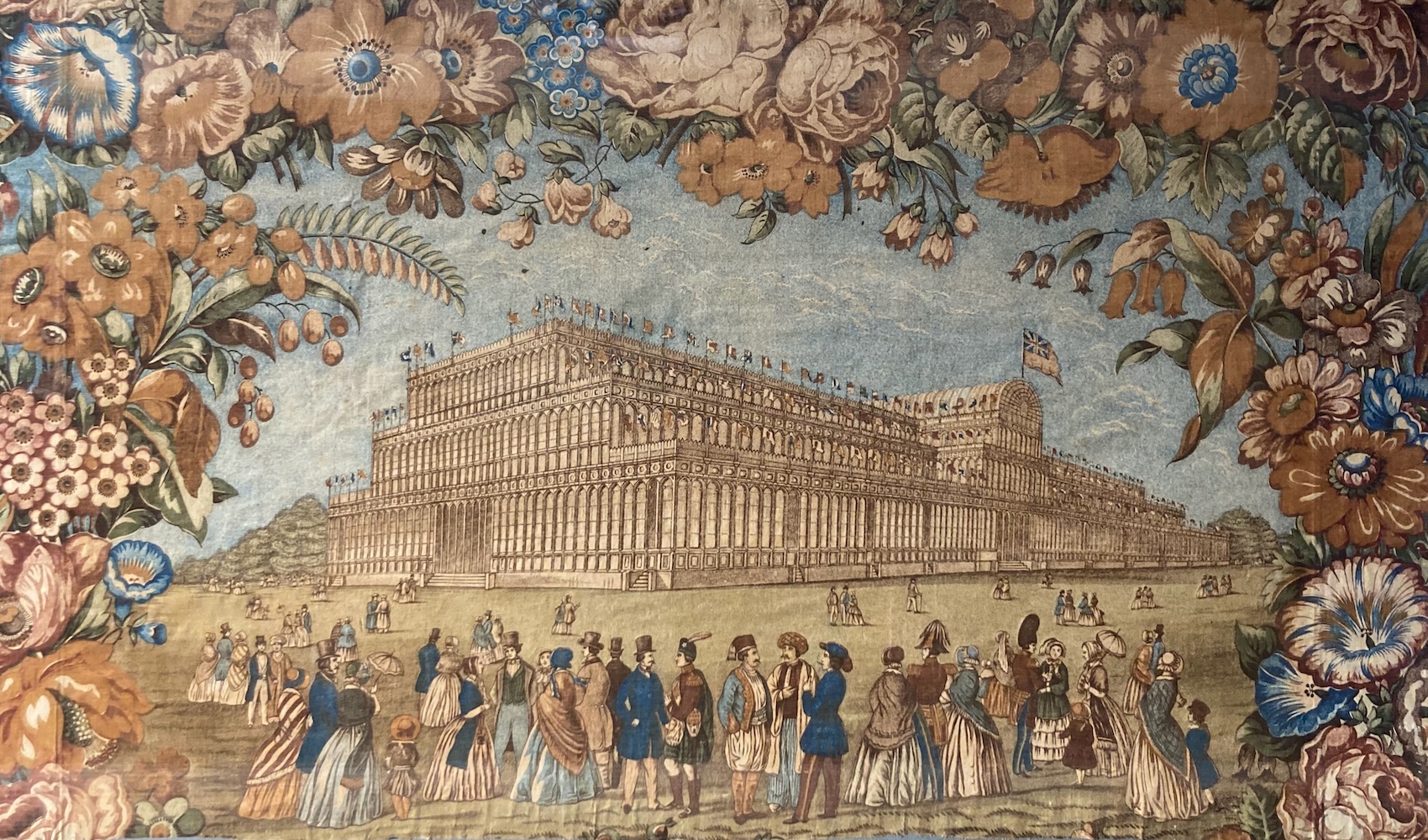


The Great Exhibition of the Works of Industry of all Nations took place in the famous Crystal Palace in London’s Hyde Park in 1851. It was accompanied by two publications: The Official Descriptive and Illustrated Catalogue and The Reports by the Juries. The exhibits were divided into thirty Classes, of which number 14 was Flax & Hemp. The entries in the Catalogue and the Reports provide a useful (if incomplete) picture of the linen industry in the United Kingdon in the mid-nineteenth century. Both of these books can be found on The Internet Archive. The entries for Flax and Hemp are found in Volume II of the Catalogue, from page 509; and from page 369 in the The Reports by the Juries.
Later in this post is an extract from the Catalogue giving an overview of the UK linen industry at the time, followed by a list of the 96 exhibitors in Class 14 from Ireland, Scotland, England and the Isle of Man.
The exhibits included flax and hemp fibre at various stages of processing; yarn and thread; twine, cords, ropes and netting; and woven linen cloth. The latter included sacking, sailcloth, muslin, cambrics, lawns and hollands; damasks, diapers, ducks, drills, dowlas, drabbets; huckabacks, creas, silesias, platillas, ticklenburgs and estopillas. Also on show were an array of finished items including clothing, napkins, handkerchiefs, tablecloths, shoelaces and tarpaulins as well as more curious items such as oyster cloths, pudding canvases, cheese strainers, and woven tube fuzee “for conveying fire underwater”!
The Map
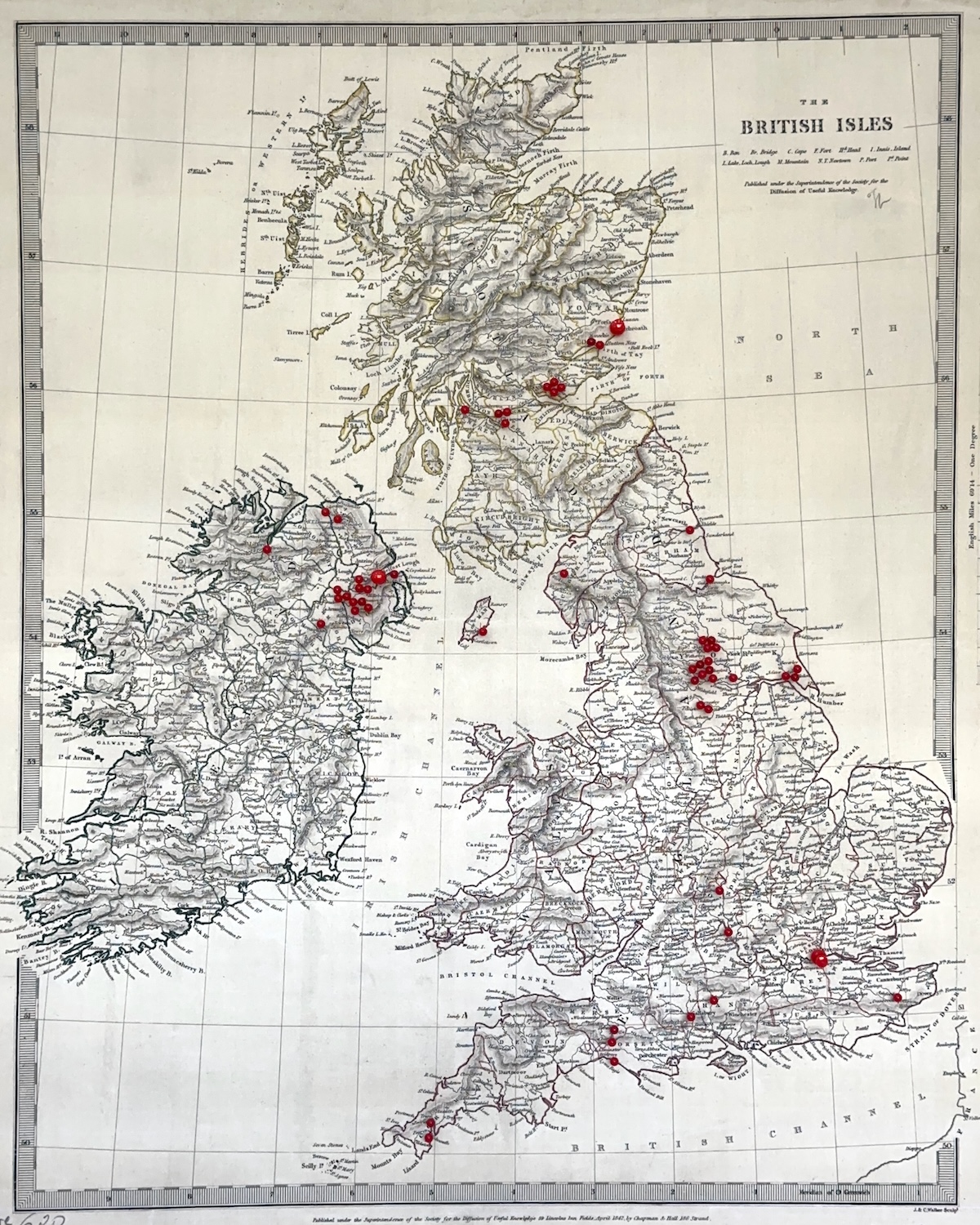
I have used the information in the Catalogue to generate a map showing the distribution across the UK of the business exhibiting in Class 14. Of course there were many businesses involved in the flax, hemp and linen industries which were not represented in the exhibition (including the Lopham linen manufacturers). Nevertheless the map, shown below, does give some impression of how widespread the linen industry remained over a century after cotton began taking its place.
On the map, each small red pin represents one exhibitor; larger red pins (Belfast, Arbroath, London) represent ten or more.
The Norfolk connection
Of particular interest to me is a passage in the Report by the Juries commending flax grown by John Warnes in Trimingham, Norfolk, and processed by Hives & Atkinson in Leeds. Warnes was a farmer and writer who campaigned for the cultivation of flax and established the Norfolk Flax Society in 1842. 1 Here is the passage:
The particular attention of the Jury was directed to the specimens of English flax, as illustrating the successful growth of that useful and valuable plant by some of the agriculturists of this country. The samples exhibited by Messrs. HIVES and ATKINSON, of Leeds, and grown by Mr. WARNES, of Trimingham, Norfolk, possess a large proportion of the necessary qualities of perfect flax, and are equal, in point of quality and strength, to any the Jury met with of similar fineness. The dressed line, with the yarns from it, are excellent, and run up to a tolerable degree of fineness…
In mill-spun yarns tnere appears to be little competition. The yarns exhibited by Messrs. HIVES and ATKINSON, of Leeds, and spun from the flax grown by Mr. WARNES (ut suprà), as already noticed, are superior in quality and spinning, without reference to price. 2
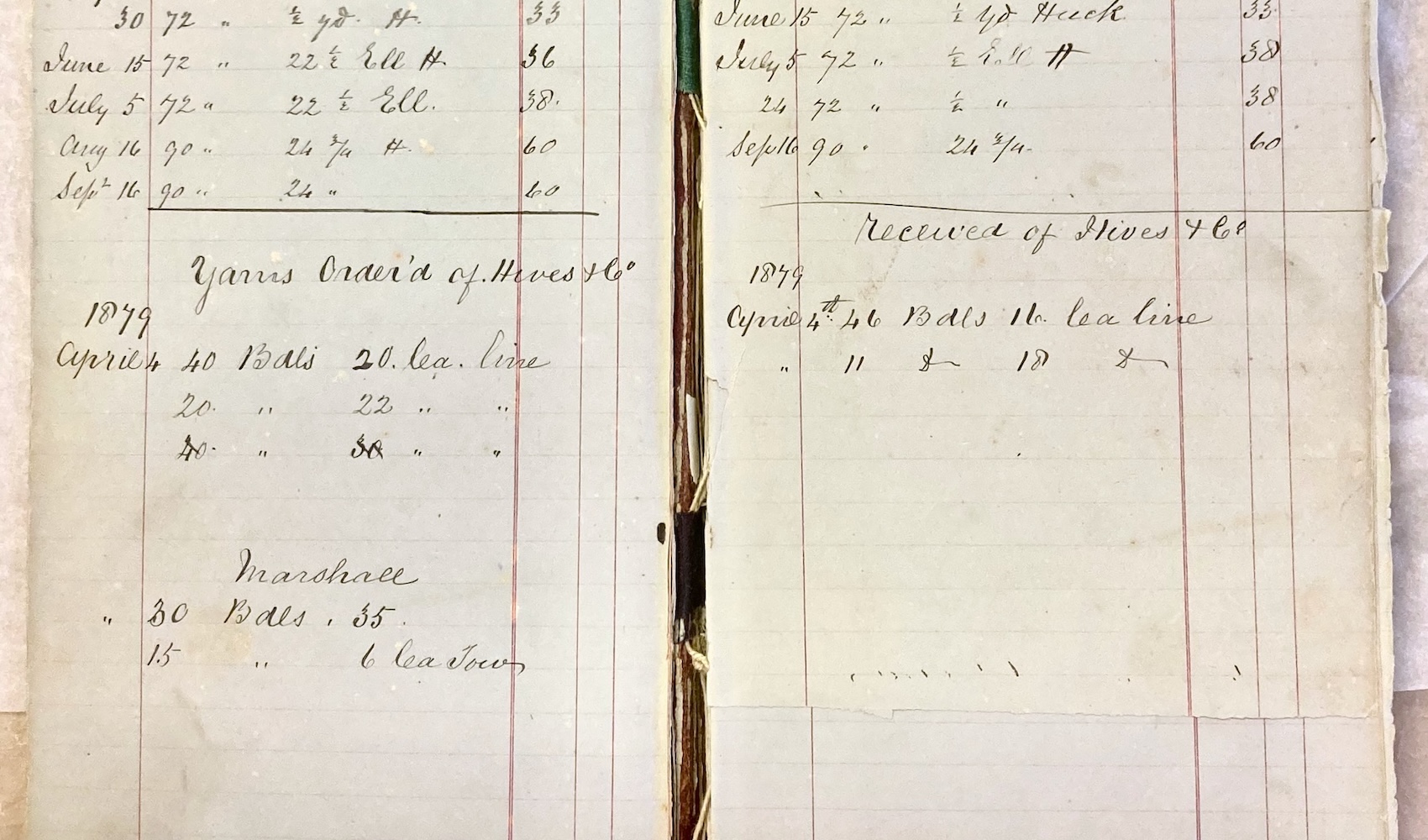
The reference here to Hives & Atkinson helps solve a mystery: in a putting-out ledger belonging to T. W. & J. Buckenham, linen weavers of North Lopham, is a note dated 1879 referring to two orders of yarn, one from “Hives & Co.” and another from “Marshall”. I have always assumed the latter referred to Marshalls of Leeds, famous flax spinners operating from 1788-1886, but “Hives & Co.” remained a puzzle. 3 I have so far discovered very little about Hives & Atkinson. They were listed amongst Flax Spinners and Agents in John Warnes “On the Cultivation of Flax” in 1847, and were clearly present at the Great Exhibition in 1851. One of their mills still stands in Leeds. Was Hives and Atkinson still in operation, perhaps without the Atkinson, in 1879? I’m still not sure. If anyone reading this knows anything more about Hives & Atkinson, or its successor, please let me know.
.
Extract from Official descriptive and illustrated catalogue. Vol 2 4
Introduction.
FLAX and Hemp formed the staple material for vegetable textile manufactures in the United Kingdom long prior to the development of the cotton trade. The application of cotton, in its present extensive degree, is altogether modern; and this material has already, in many instances, entirely, and in others in part, replaced flax and hemp, and the substitution is continually proceeding in fresh directions. For many purposes, however, cotton does not appear to offer itself as a probable substitute for the materials concerned in this Class. remarkable difference in the conducting properties (for heat) possessed by cotton and flax alone seems to assign a separate use to them in textile manufacture, which, coupled with their different physical and mechanical properties, will probably always render their employment in textile fabrics distinct.
The Class comprehends the following sub-Classes:-A. Flax-fibre, in its various conditions, as Steeped and Unsteeped, Heckled, &c. ; B. Linen Yarn and Thread; C. Plain Linens of all widths, Bleached, Unbleached and Dyed; D. Damasks, Diapers, Drills, and other Twilled Linens; E. Cambrics, Cambric and Linen Hand-kerchiefs, Lawns, &c.; F. Cordage of all kinds.
The position occupied by the objects in this Class in the Exhibition Building is near the Western Entrance on the south side of the Nave, Ground Floor. The Areas devoted to their reception are L. and M. 6 to 8, and N. and O. 4 to 6. On the North Wall, also, in a recess near the flax machinery, in Class V., are placed specimens of heavy canvas, sail-cloth, &c., and in a part of the space occupied by Class XI., will also be found various manufactures belonging to the present Class.
A great variety of damasks of different kinds are exhibited. The design of several of these represents in a forcible manner the success with which the Jacquard principle is applied to the ornamentation of fabrics for ordinary use. The localities supplying these and similar articles are chiefly Belfast, Dunfermline, Barnsley, and Manchester.
Some interesting collections of the materials used, and of its first stages of preparation for manufacture, are likewise shown. The most ordinary articles such as sacks, threads, fishing-nets, ropes, and twine, have all a place of interest and importance in this Class. The heavier descriptions of flax manufactures are supplied chiefly from Dundee, Hull, Greenock, and Arbroath. The machinery necessary to weave some of these productions, such as sail-canvas, sacking, & c., presents a forcible contrast by the size and power of its parts to the lighter and more elegant machines employed for weaving the fine cambrics used for pocket-hand-kerchiefs.
Specimens of articles manufactured from different kinds of flax and hemp will also attract notice, and illustrate the peculiar applicability of these sorts for different fabrics. Jute, a fibrous material of recent introduction from the East Indies, is becoming extensively employed, particularly for carpetings, sacking, bags, &c., in which a fine material is not necessary. The beautiful flax prepared at Courtrai, and adapted exclusively for the most delicate fabrics, is employed in the manufacture of many of the articles exhibited. British, Russian, China, and Manilla hemp, enter into the composition of others.
In 1841, upwards of one million and a quarter cwts. of flax and tow were imported into England at a duty one penny a cwt., yielding consequently about 5,500l. to the revenue. The flax factories in the United Kingdom are of great size and importance, and employ a large number of operatives in immediate or indirect connexion with them. If it should become possible to obtain cheaply an adequate supply of flax of home production, and of the fit quality for the purposes of the spinner, the dependency of this country upon the East and America for cotton as a textile material would be greatly lessened, and an important field of commercial activity would be laid open at our own doors. But the properties of flax, and the tedious process is necessary for its preparation, have hitherto proved an obstacle to its more extensive employment. A variety of experiments on this subject are however in progress, the ultimate result of which can scarcely be foreseen; and it appears already to have been proved by actual trial that this fibre can, after preparation, be applied to the ordinary machinery of the cotton-mill, yarn having been spun up to moderate numbers from flax thus prepared. Until recently flax cultivation has scarcely been fairly attempted; but it seems probable that in a short time extensive, and it may be hoped successful, trials will be made to supply this country with a manufacturing material so intrinsically valuable.- R. E.
List of Exhibitors in Class 14 of The Great Exhibition, from The Official Descriptive and Illustrated Catalogue
Northern Ireland (22)
Belfast (10)
Andrews, Michael
Bernard & Co
Carson, R.
Corry, Blain, & Co.
Holden, John, & Co.
Leadbetter, John, & Co.
Lord Dufferin’s School
Pelling, Charles
Richardson, Sons, & Owden
Sadler, Fenton & Co.
Dromore, County Down
McCay, Thomas
McMurray, Thomas, & Co.
Waringstown, County Down
Brown, John, & Sons
Henning, John
Coleraine, County Londonderry
Bennett & Adams
Ballymoney, County Antrim
Pinkerton, James & Robert,
Lisburn, County Antrim
Coulson, James & Co
Coulson, William,
Richardson & Co.,
Keady, County Armagh
Kirk, William, & Son,
Lurgan, County Armagh
Bell, Thomas, & Co.
Richardson, J. & T., & Co. Malcolm.
Scotland (19)
Arbroath
Anderson, C.
Curr & Co.
Duncan, D. & Co.
Fraser, D.
Garland, W.
Gordon, G. & A.
Nicol, A. & Co.
Ramsey & Smart
Renny, Sons & Co.
Salmond, W.
Dundee
Dundee Local Committee
Cox Brothers
Dunfermline
Beveridge, E.
Birrell, David
Hunt, W., & Son
Kinnis, W.
Greenock
Gourock ropeworks
Glasgow
Finlayson, Bonfield & Co.
Fletcher, Alexander
Jeffrey, Robert
England (50)
Newcastle
Plummer, R.
Gateshead, Tyne and Wear
Hartford, George
Cockerouth, Cumbria
Harris, Jonathan
Stockton-on-Tees, Durham
Dixon & Longstaff
Brompton, Yorkshire
Wilford, John, & Sons,
Knaresborough
Walton & Co. (all made by hand-loom.)
Emshall, George,
Leeming, James (all made by hand-loom.)
Leeds
Houldsworth & Co.
Pegler, Charles
Schwann, Frederick (also in Huddersfield)
Titley, Tatham & Walker
Grimshaw & Wilkinson
Marshall & co (under class 4)
Hives & Atkinson
Selby, Yorkshire
Cator, Nelson & Co.
Hull, Yorkshire
Jameson & Co,
Hall, John & Co.
Spyvee & Coopers
Barnsley, Yorkshire
Carter Brothers; Canter, Joseph; Jackson & Matthewman; Fletcher, Henry T,; Hattersley, Parkinson, & Co.; Pigott & Newton; and Haxworth & Carnley
Tee, Charles, & Son
Banbury, Oxfordshire
Wall, E. & T.
Oxford, Oxfordshire
Day, John (Church bell ropes)
London (mainly in Cheapside, presumably dealers rather than manufacturers?)
Crawford & Lindsays
Sadler, S.
Wilks, J.
Rogers & Wroe
Devas, M. T., Minchener, & Routledge
Dewar & Sons
Hayward, R., & Sons
Morrison & Hurn
Soper, Richard
Smith, J
Huddart, Sir Joseph and Co.
Tull, Samuel
Dagnall, Charles
Edgington, Thomas
Sadler, Samuel
Capper, John & Son
McLeownan, John & Co
Ullathornes & Longstaffs
Ashford, Kent
Houghton, Sarah
Salisbury, Wiltshire
Holloway, Thomas John
Andover, Hampshire
Beale, Brown
South Petherton, Somerset
Poole, James & Charles
Crewkerne, Somerset
Row, J
Withey & Smith
Bridport, Dorset
Edwards, John
Falmouth, Cornwall
Fishing nets
Truro, Cornwall
Hawke, E. H. (Ropes, fuzee)
Isle of Man
Douglas
Moore, William
Notes
- See Searle, A. & Tuck, J. (1999) “The King’s Flax”. John Warnes was the author of “On the Cultivation of Flax” (1847). ↩︎
- Reports by the Juries, p.370 ↩︎
- For more about this see my blog The Buckenham Ledger ↩︎
- Official Descriptive and Illustrated Catalogue. Vol 2,
p. 509 ↩︎